
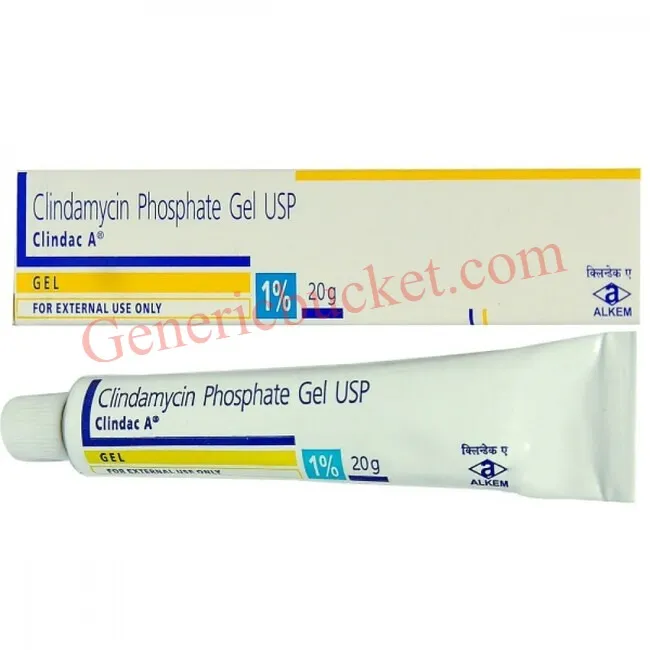

Clindac A Gel (Clindamycin Phosphate 1%) 15gm
Price range: $38.00 through $104.00
| Country of Origin | india |
|---|---|
| Dosage Form | Gel |
| Equivalent Brand | Cleocin T |
| Generic Name | Clindamycin |
| Indication | Acne |
| Manufacturer | Galderma India Pvt Ltd |
| Packaging | 15gm in 1 Tube |
| Composition | Clindamycin (1% w/w) |
| Clindac A Gel (Clindamycin Phosphate 1%) 15gm | |||
| Pack Size | Price | Price/Unit | Add To Cart |
| 3 Tube/s | $38.00 (12.67/unit) | $12.67 | |
| 6 Tube/s | $72.00 (12/unit) | $12 | |
| 9 Tube/s | $104.00 (11.56/unit) | $11.56 | |
Clindac A Gel is a prescription topical antibiotic containing clindamycin 1% w/w. It is commonly prescribed for acne vulgaris, particularly inflammatory acne affecting areas such as the face, chest, or back. The medicine works locally on the skin to reduce acne-associated bacteria and inflammation. Current product information identifies clindamycin 1% w/w as the active ingredient in Clindac A Gel.
Acne can develop when excess oil, dead skin cells, inflammation, and bacteria contribute to blocked pores. Clindac A Gel addresses the bacterial component of acne rather than simply covering the appearance of pimples. Clindamycin belongs to the lincosamide class of antibiotics and inhibits bacterial protein synthesis by binding to the 50S ribosomal subunit.
What Is Clindac A Gel Used For?
Doctors primarily prescribe Clindac A Gel for acne vulgaris. It can be particularly useful when acne includes red, swollen, or pus-filled inflammatory lesions. By reducing susceptible acne-associated bacteria and helping control inflammation, topical clindamycin can support clearer-looking skin as part of an appropriate acne treatment plan.
It is important to understand that Clindac A Gel does not work like a cosmetic acne cleanser. It contains an antibiotic and should therefore be used only according to professional medical advice. It should not be used casually for every type of skin blemish, because not every bump or rash represents bacterial acne.
How Does Clindac A Gel Work?
The active ingredient, clindamycin, interferes with bacterial protein production. This limits the ability of susceptible bacteria to grow and multiply. The FDA prescribing information for topical clindamycin identifies clindamycin topical preparations for the treatment of acne vulgaris and describes this antibacterial mechanism.
When you use Clindac A Gel correctly, the medicine works directly on the treated skin. Improvement does not necessarily occur immediately. Acne treatment often requires consistent use over time, and your healthcare professional determines how long you should continue therapy.
How to Apply Clindac A Gel
Before applying Clindac A Gel, gently clean and dry the affected skin. Apply a thin layer to the areas directed by your prescriber. Wash your hands before and after application unless your hands themselves require treatment. Avoid applying the gel to the eyes, lips, inside of the nose, or other sensitive mucous membranes.
Do not apply more product than prescribed. Using extra gel will not necessarily make acne disappear faster and may increase the chance of irritation. Product instructions for clindamycin 1% gel recommend applying a thin layer to clean, dry skin according to the prescribed regimen.
If you forget an application, follow your prescriber’s instructions or the product information. Do not routinely double the amount to compensate for a missed dose.
Benefits of Clindac A Gel
One important benefit of Clindac A Gel is its targeted topical action. Instead of taking an antibiotic by mouth, you apply the medicine directly to the acne-affected skin. For appropriate patients, topical clindamycin can help reduce inflammatory acne as part of a broader treatment strategy.
The gel formulation also makes it practical to apply a thin layer to affected areas. However, patients should remember that an antibiotic alone may not be the best long-term acne strategy. Antibiotic resistance can develop with clindamycin use. FDA information documents resistance to clindamycin among acne-associated bacteria.
For this reason, your dermatologist or prescriber may combine topical clindamycin with another acne treatment, depending on the severity and type of acne.
Related Product
Clindac A Gel Side Effects
Some people using Clindac A Gel may experience local skin reactions such as dryness, redness, burning, itching, or irritation. These effects may be mild, but you should tell your healthcare professional if they become persistent or severe.
Although topical clindamycin produces much lower systemic exposure than oral or injectable clindamycin, some of the medicine can still be absorbed through the skin. FDA labeling warns about the possibility of antibiotic-associated diarrhea and colitis with topical clindamycin.
Contact a healthcare professional promptly if you develop significant or persistent diarrhea, particularly if it is watery or bloody, during or after treatment. Do not ignore these symptoms.
Precautions Before Using Clindac A Gel
Tell your healthcare professional if you have previously experienced an allergic reaction to clindamycin or lincomycin. You should also discuss any history of antibiotic-associated colitis, ulcerative colitis, or other significant bowel disease before starting treatment. FDA labeling lists these conditions among important contraindications or precautions for topical clindamycin products.
Avoid sharing Clindac A Gel with another person, even if that person appears to have similar acne. Prescription acne treatment should match the individual’s diagnosis, skin condition, medical history, and other medications.
Why Antibiotic Stewardship Matters
Patients should use Clindac A Gel only for the condition for which it was prescribed. Do not use it longer than recommended without medical advice. Bacteria can become resistant to antibiotics, potentially reducing the effectiveness of future treatment. FDA information specifically recognizes clindamycin resistance as an issue in acne therapy.
Your dermatologist may recommend an additional non-antibiotic acne treatment to improve results and reduce the need for prolonged antibiotic exposure. Follow the complete treatment plan rather than changing the regimen yourself.
Storage and Handling
Store Clindac A Gel according to the product label and pharmacy instructions. Current product information for the 1% gel lists storage below 25°C. Keep the container properly closed and away from excessive heat. Keep medicines out of the reach of children.
Who Should Consider Clindac A Gel?
Clindac A Gel may be appropriate for people whose healthcare professional has diagnosed acne vulgaris and determined that topical clindamycin is suitable. It is not appropriate for every acne case. People with mild comedonal acne, severe acne, suspected hormonal acne, rosacea, folliculitis, or another skin disorder may need a different treatment approach.
A dermatologist or qualified prescriber can determine whether Clindac A Gel fits your individual treatment plan.
Frequently Asked Questions
1. Is Clindac A Gel an antibiotic?
Yes. Clindac A Gel contains clindamycin 1% w/w, a topical antibiotic used for acne vulgaris.
2. Can Clindac A Gel cure acne permanently?
No acne medicine can guarantee a permanent cure. Clindac A Gel can help manage inflammatory acne when prescribed appropriately, but acne may return after treatment.
3. Can I use Clindac A Gel for every pimple?
No. Use it only as directed by your healthcare professional. Not every skin lesion results from bacteria or requires an antibiotic.
4. Can I use Clindac A Gel with other acne products?
Sometimes. Your dermatologist may recommend another treatment, but you should check before combining products to avoid irritation or inappropriate antibiotic use.
5. How long does Clindac A Gel take to work?
Results vary between individuals. Consistent use is important, and your prescriber can assess your progress and determine whether treatment should continue.
Be the first to review “Clindac A Gel (Clindamycin Phosphate 1%) 15gm”
Related products



Reviews
There are no reviews yet.