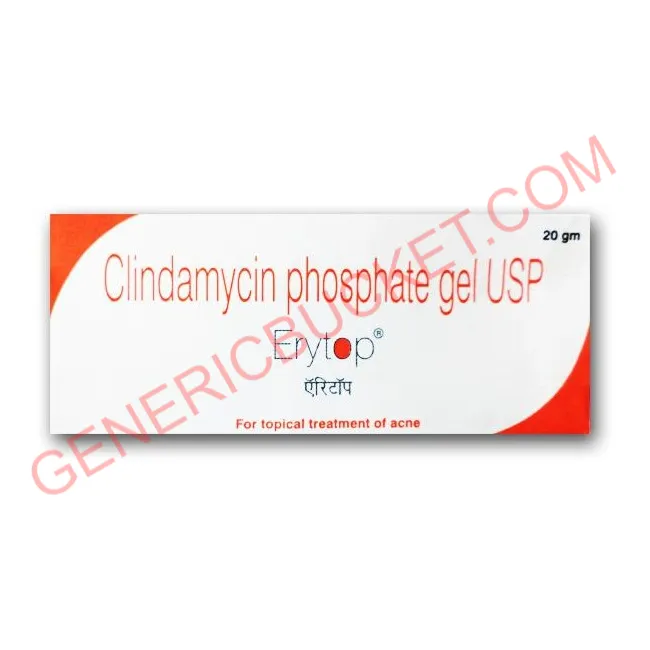

Erytop Gel (Clindamycin 1%)
Price range: $30.00 through $105.00
| Country of Origin | india |
|---|---|
| Dosage Form | Gel |
| Equivalent Brand | Cleocin T |
| Generic Name | Clindamycin |
| Indication | Acne |
| Manufacturer | USV Pvt Ltd |
| Packaging | 20 gm in 1 tube |
| Composition | Clindamycin (1% w/w) |
| Erytop Gel (Clindamycin 1%) | |||
| Pack Size | Price | Price/Unit | Add To Cart |
| 3 Tube/s | $30.00 (10/unit) | $10 | |
| 6 Tube/s | $55.00 (9.17/unit) | $9.17 | |
| 12 Tube/s | $105.00 (8.75/unit) | $8.75 | |
Erytop Gel is a prescription topical antibiotic containing clindamycin 1% w/w, and healthcare professionals commonly prescribe it for acne vulgaris. The product is manufactured by USV Private Limited and is intended for external application to affected skin. Current product listings identify clindamycin 1% as its active ingredient and acne as its primary use.
Acne develops when hair follicles become blocked with oil and dead skin cells and inflammation contributes to pimples. Erytop Gel helps manage acne by delivering clindamycin directly to the affected skin. Clindamycin is a lincosamide antibiotic that inhibits bacterial protein synthesis, thereby reducing the growth of susceptible bacteria associated with acne. FDA prescribing information for topical clindamycin also recognizes topical clindamycin products for the treatment of acne vulgaris.
How Erytop Gel Works
The active ingredient, clindamycin phosphate, converts to active clindamycin after application. Clindamycin acts against susceptible bacteria by binding to the 50S ribosomal subunit and interfering with bacterial protein production. This antibacterial activity can help reduce inflammatory acne lesions and associated redness.
However, Erytop Gel should not be described as a permanent cure for acne. Acne can have several contributing factors, including excess oil production, follicular blockage, hormones, inflammation, and bacterial involvement. Treatment aims to control active breakouts and reduce the development of new lesions rather than guarantee that acne will never return.
Uses and Potential Benefits
Doctors primarily prescribe Erytop Gel for inflammatory acne and other forms of acne vulgaris where topical antibiotic treatment is appropriate. It may be used on areas such as the face, chest, or back when prescribed for those locations.
The potential benefits of Erytop Gel include helping reduce acne-causing bacterial activity, calming inflammatory pimples, and improving the overall appearance of acne-prone skin when used consistently. It works locally on the skin, and topical clindamycin produces substantially lower systemic exposure than oral clindamycin, although some absorption can occur.
Do not apply this medicine simply because you have occasional pimples. A healthcare professional should determine whether an antibiotic is appropriate for your acne. Antibiotic stewardship matters because acne bacteria can develop resistance to clindamycin. FDA information documents resistance concerns with topical clindamycin, which is one reason clinicians may combine topical antibiotics with benzoyl peroxide or select a different acne treatment depending on the patient’s condition.
How to Use Erytop Gel
Use Erytop Gel exactly according to your prescriber’s instructions. Before application, gently cleanse the affected area and allow the skin to dry. Apply a thin layer over the prescribed area rather than using a large amount. Wash your hands before and after application unless your hands themselves require treatment. Current product information similarly recommends applying the gel to clean, dry skin and using it consistently as prescribed.
Avoid getting Erytop Gel into your eyes, mouth, nose, or other sensitive areas. Do not apply it to cuts, severely irritated skin, or damaged areas unless your clinician specifically instructs you to do so. Using more gel will not necessarily make acne disappear faster and may increase irritation.
Continue treatment for the duration prescribed. Acne treatment generally requires consistent use, and you may need several weeks before you notice meaningful improvement. Do not stop or extend antibiotic treatment on your own.
Possible Side Effects
Some people using Erytop Gel experience local skin reactions. Reported effects can include dryness, redness, itching, burning, peeling, irritation, or changes in skin oiliness.
Mild irritation may improve as your skin adjusts, but contact your healthcare professional if irritation becomes severe, persistent, or increasingly uncomfortable.
Although topical clindamycin produces low systemic exposure, clinically important gastrointestinal adverse effects, including antibiotic-associated diarrhea and colitis, have been associated with topical clindamycin products. Seek medical attention if you develop significant or persistent diarrhea, especially if it becomes watery or bloody.
Important Safety Information
Do not use Erytop Gel if you have previously experienced an allergic reaction to clindamycin, lincomycin, or another ingredient in the product. People with a history of inflammatory bowel disease, ulcerative colitis, regional enteritis, or antibiotic-associated colitis should discuss their medical history with a healthcare professional before using topical clindamycin.
Tell your prescriber about other prescription medicines, over-the-counter products, and topical acne treatments you use. Avoid combining multiple irritating skincare products without professional advice. Gentle cleansing and non-comedogenic moisturizers can help support the skin barrier during acne treatment.
Pregnant or breastfeeding patients should discuss treatment with their healthcare professional before using prescription acne medicines. Your clinician can determine whether topical clindamycin is appropriate for your individual circumstances.
Storage and Handling
Store Erytop Gel according to the product label and keep the tube tightly closed when not in use. Current product listings advise storage below 25°C for this formulation. Keep the medicine away from excessive heat and moisture and out of children’s reach.
Who Should Consider Erytop Gel?
Erytop Gel may be appropriate for people whose healthcare professional has diagnosed acne and determined that topical clindamycin is suitable. It is not an appropriate treatment for every type of skin eruption. Conditions such as rosacea, folliculitis, allergic dermatitis, fungal infections, or other rashes can resemble acne but require different treatment.
A pharmacist or prescriber can help identify whether your symptoms fit acne and whether clindamycin provides an appropriate treatment option.
Frequently Asked Questions
What is Erytop Gel used for?
Erytop Gel is a topical prescription antibiotic containing clindamycin 1% w/w. It is primarily used to treat acne vulgaris and helps reduce susceptible bacteria associated with inflammatory acne.
Can Erytop Gel permanently cure acne?
No. Erytop Gel helps control acne but should not be presented as a permanent cure. Acne can recur because multiple factors contribute to the condition.
How long does Erytop Gel take to work?
Improvement may take several weeks of consistent treatment. Follow your prescriber’s directions rather than increasing the amount or frequency when results appear slowly.
Can I use Erytop Gel every day?
Use it at the frequency prescribed by your healthcare professional. Do not increase applications on your own because excessive application can increase irritation without necessarily improving results.
Can I apply Erytop Gel to my whole face?
Only apply it to the areas your prescriber recommends. Avoid the eyes, lips, inside of the nose, and other sensitive areas.
Related products


Acne