


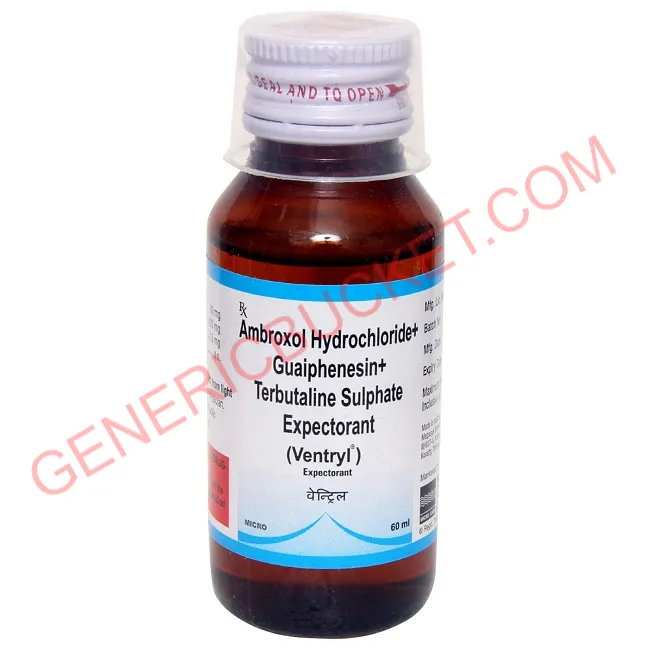

Ventryl Expectorant (Ambroxol 30mg / Guaifenesin 100mg / Terbutaline 2.5mg) 60ml
Price range: $35.00 through $98.00
| Country of Origin | india |
|---|---|
| Dosage Form | Expectorant |
| Generic Name | Ambroxol |
| Indication | Cough with mucus |
| Packaging | 60 ml in 1 bottle |
| Manufacturer | Micro Labs Ltd |
| Composition | Ambroxol (30mg/5ml) + Guaifenesin (100mg/5ml) + Terbutaline (2.5mg/5ml) |
| Ventryl Expectorant (Ambroxol 30mg / Guaifenesin 100mg / Terbutaline 2.5mg) 60ml | |||
| Pack Size | Price | Price/Unit | Add To Cart |
| 3 Bottle/s | $35.00 (11.67/unit) | $11.67 | |
| 6 Bottle/s | $68.00 (11.33/unit) | $11.33 | |
| 9 Bottle/s | $98.00 (10.89/unit) | $10.89 | |
Ventryl Expectorant is a prescription cough medicine formulated to help relieve a productive cough associated with mucus and make breathing more comfortable. It contains a combination of ambroxol, guaifenesin, and terbutaline, which work through different mechanisms to loosen mucus, promote its clearance, and relax narrowed airway muscles. Current product references list the standard formulation as ambroxol 30 mg, guaifenesin 100 mg, and terbutaline 2.5 mg per 5 mL, marketed by Micro Labs Ltd.
What Is Ventryl Expectorant Used For?
Ventryl Expectorant is primarily used for cough accompanied by thick or excessive mucus. A productive cough occurs when the respiratory tract produces sputum that the body needs to remove. Instead of simply suppressing this protective cough, the medicine helps make mucus easier to clear.
Doctors may prescribe this type of expectorant combination when mucus and airway narrowing contribute to respiratory symptoms. Product information describes its use for cough with mucus and conditions where airway secretions make coughing difficult.
It is important to understand that Ventryl Expectorant does not cure every cause of cough. A cough may result from a viral infection, asthma, allergies, bronchitis, chronic lung disease, reflux, or other conditions. Your healthcare professional should determine the underlying cause before recommending treatment.
How Does Ventryl Expectorant Work?
The three active ingredients in Ventryl Expectorant complement each other.
Ambroxol acts as a mucolytic. It helps reduce the thickness and stickiness of respiratory mucus, allowing you to cough up phlegm more easily.
Guaifenesin works as an expectorant. It increases the water content of respiratory secretions and helps make mucus less difficult to expel. Adequate fluid intake may also support mucus clearance unless your doctor has instructed you to restrict fluids.
Terbutaline is a bronchodilator. It relaxes smooth muscles around the airways, helping widen them and potentially making breathing easier.
Because these ingredients address mucus and airway obstruction in different ways, the combination can be useful when a productive cough occurs together with airway tightness.
Key Benefits
When prescribed appropriately, Ventryl Expectorant may provide several useful benefits. It can help loosen thick phlegm, support the removal of mucus through coughing, and improve the ease of breathing when bronchial narrowing contributes to symptoms.
The medicine may be particularly helpful when a wet or chesty cough produces troublesome mucus. However, you should not use it simply because you have any cough. A dry cough, for example, may require a different approach.
Remember that symptom improvement does not necessarily mean that the underlying respiratory condition has completely resolved. Follow the treatment plan provided by your healthcare professional.
How to Take Ventryl Expectorant
Take Ventryl Expectorant exactly as prescribed. The appropriate dose and treatment duration depend on your age, medical condition, other medicines, and response to treatment. Do not increase the dose or take it more frequently because doing so may increase the risk of adverse effects.
Shake the bottle well before measuring a dose. Use the measuring cup, oral syringe, or other dosing device supplied with the product rather than an ordinary household spoon. Product guidance recommends taking the prescribed amount by mouth, with or without food; taking it with food may help people who experience stomach discomfort.
Do not stop a prescribed course prematurely without discussing it with your clinician, particularly when the medicine forms part of treatment for an ongoing respiratory condition.
Possible Side Effects
Like other medicines, Ventryl Expectorant can cause side effects. Reported effects include nausea, vomiting, stomach discomfort, headache, dizziness, nervousness, tremor, skin rash, palpitations, and an increased heart rate.
Terbutaline can sometimes cause shakiness or a faster heartbeat because of its bronchodilating effects. If symptoms become severe, persistent, or concerning, contact your healthcare professional.
Seek urgent medical attention for serious symptoms such as severe difficulty breathing, swelling of the face or throat, fainting, or signs of a severe allergic reaction.
Important Precautions
Before using Ventryl Expectorant, tell your healthcare professional about all medicines and supplements you take. Also discuss any history of heart problems, high blood pressure, diabetes, thyroid disease, kidney or liver problems, seizures, or other significant medical conditions. Product information specifically advises caution in several of these situations.
Tell your doctor if you are pregnant, planning pregnancy, or breastfeeding. Children should receive this medicine only when a qualified healthcare professional has specifically recommended it and determined an appropriate dose.
Because dizziness or drowsiness can occur in some people, avoid driving or operating machinery until you know how the medicine affects you.
Storage and Handling
Store Ventryl Expectorant according to the package instructions. Current product information lists storage below 30°C. Keep the bottle tightly closed and away from excessive heat, moisture, and direct sunlight. Keep all medicines out of children’s reach.
Is Ventryl Expectorant an Antibiotic?
No. Ventryl Expectorant is not an antibiotic. Its active ingredients help manage mucus and airway symptoms; they do not directly treat bacterial infections. If your cough results from a bacterial infection, your clinician will decide whether an antibiotic or another treatment is appropriate.
Frequently Asked Questions
1. What is Ventryl Expectorant used for?
It is primarily used for cough associated with mucus. Its ingredients help loosen respiratory mucus and relax airway muscles when appropriate.
2. Does Ventryl Expectorant treat dry cough?
It is primarily intended for cough associated with mucus. A dry cough may require a different treatment depending on its underlying cause.
3. Can I take Ventryl Expectorant without a prescription?
Current listings identify the product as a prescription medicine. Use it only according to advice from an appropriately qualified healthcare professional.
4. Can children take Ventryl Expectorant?
Do not give this medicine to a child unless a healthcare professional has specifically recommended it and provided the appropriate dose. Children require careful assessment because cough medicines are not appropriate for every pediatric respiratory illness.
5. Is Ventryl Expectorant an antibiotic?
No. It is an expectorant/bronchodilator combination and does not replace antibiotic treatment when an antibiotic is medically indicated.
Be the first to review “Ventryl Expectorant (Ambroxol 30mg / Guaifenesin 100mg / Terbutaline 2.5mg) 60ml”
Related products








Reviews
There are no reviews yet.