
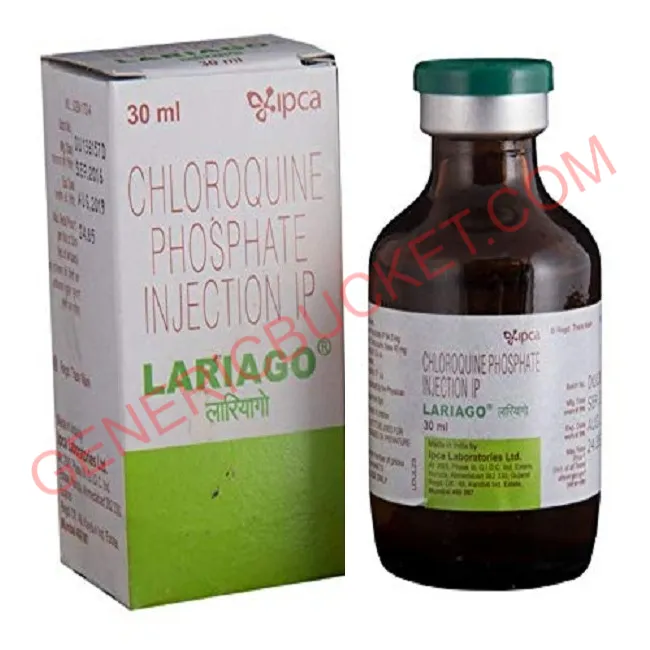

Lariago Injection (Chloroquine 40mg) 30ml
Price range: $30.00 through $110.00
| Country of Origin | india |
|---|---|
| Dosage Form | Injection |
| Generic Name | Chloroquine |
| Indication | Malaria |
| Packaging | 30 ml in 1 vial |
| Manufacturer | Ipca Laboratories Ltd |
| Composition | Chloroquine (40mg) |
| Lariago Injection (Chloroquine 40mg) 30ml | |||
| Pack Size | Price | Price/Unit | Add To Cart |
| 5 Injection/s | $30.00 (6/unit) | $6 | |
| 10 Injection/s | $58.00 (5.8/unit) | $5.8 | |
| 20 Injection/s | $110.00 (5.5/unit) | $5.5 | |
Lariago Injection is a prescription antimalarial injection containing chloroquine phosphate, used under medical supervision for appropriate malaria infections when injectable treatment is clinically necessary. Product information from Indian regulatory sources identifies the formulation as chloroquine phosphate equivalent to chloroquine base, while current pharmacy listings identify Lariago Injection as a prescription medicine marketed by Ipca Laboratories.
Important: This product description is for educational and SEO purposes and does not replace a clinician’s diagnosis or prescribing instructions. Lariago Injection should not be self-administered. A healthcare professional must determine whether chloroquine is appropriate for the specific malaria species, resistance pattern, patient age, weight, medical history, and severity of infection.
What Is Lariago Injection?
Lariago Injection contains chloroquine, an established antimalarial medicine. Indian regulatory records list Lariago Injection as containing 64.5 mg of chloroquine phosphate per mL, equivalent to 40 mg of chloroquine base per mL. Available presentations can differ, so healthcare professionals should verify the exact strength and pack before administration.
Chloroquine works primarily against susceptible blood-stage malaria parasites. It interferes with the parasite’s ability to handle hemoglobin-derived heme, ultimately damaging the parasite and helping clear the blood-stage infection. However, chloroquine does not work against every malaria parasite because resistance is widespread in some regions. Therefore, clinicians should select antimalarial therapy according to current resistance patterns and the suspected or confirmed Plasmodium species.
What Is Lariago Injection Used For?
Lariago Injection may be used for malaria when a clinician determines that parenteral chloroquine is appropriate, particularly when oral treatment is temporarily unsuitable. Current product information describes its use for malaria, and pharmacy references identify it as a prescription injectable antimalarial.
In the United States, chloroquine remains an established antimalarial drug, but the appropriate drug depends heavily on where malaria was acquired and whether the parasite is susceptible. FDA labeling for chloroquine phosphate states that it is indicated for susceptible strains of Plasmodium falciparum, P. malariae, P. ovale, and P. vivax, while warning against its use where chloroquine resistance occurs.
This distinction matters because choosing an ineffective antimalarial can allow malaria to progress. Patients with severe or complicated malaria require urgent hospital management and an appropriate parenteral antimalarial rather than attempting to treat themselves with a product purchased online.
How Does It Work?
The active ingredient, chloroquine, concentrates within malaria parasites and interferes with their processing of hemoglobin. This creates toxic conditions inside susceptible parasites and helps eliminate the blood-stage organisms.
Although Lariago Injection can treat susceptible blood-stage malaria, it does not eradicate dormant liver-stage hypnozoites responsible for relapses of P. vivax and P. ovale. FDA information explains that an additional 8-aminoquinoline medicine is needed for radical cure of these infections when appropriate.
Related Product
How Is Lariago Injection Given?
Lariago Injection must be administered by a qualified healthcare professional. The route, dose, dilution, administration rate, frequency, and duration depend on the specific formulation and the patient’s clinical condition. Older FDA labeling for injectable chloroquine describes parenteral use when necessary, followed by oral therapy as soon as practical; however, clinicians should follow the current applicable product labeling and modern malaria-treatment guidance rather than relying on historical dosing instructions.
Never inject this medicine yourself or ask an unqualified person to administer it. A healthcare professional should also monitor the patient when clinically indicated, particularly because chloroquine can affect cardiac conduction and other organ systems.
Important Safety Information
Before receiving Lariago Injection, tell your healthcare professional about kidney or liver disease, heart disease, abnormal heart rhythm, electrolyte abnormalities, seizure disorders, eye or retinal problems, blood disorders, glucose problems, psoriasis, porphyria, pregnancy, breastfeeding, allergies, and all medicines or supplements you use.
Chloroquine can cause serious adverse reactions. Cardiac toxicity, QT prolongation, ventricular arrhythmias, and cardiomyopathy have been reported with chloroquine. The risk becomes particularly important when patients have pre-existing cardiac conditions or take other medicines that prolong the QT interval.
Seek urgent medical attention for fainting, severe palpitations, chest discomfort, significant breathing difficulty, seizures, severe weakness, confusion, or serious visual changes.
Possible adverse effects can include gastrointestinal symptoms, headache, dizziness, itching, visual disturbances, muscle weakness, and changes in heart rhythm. Serious reactions require immediate medical assessment.
Drug Interactions
Lariago Injection may interact with medicines that affect cardiac rhythm or alter chloroquine exposure. Patients should provide a complete medication list before treatment. Particular attention may be necessary with certain antiarrhythmics, some antibiotics, antimalarials, antidiabetic medicines, and other drugs known to interact with chloroquine.
Do not begin, stop, or combine medicines without professional advice. Your clinician may need to review kidney and liver function, cardiac risk, concurrent medications, and the likely malaria organism before selecting treatment.
Why Medical Supervision Matters
Lariago Injection is not a general-purpose fever injection. Malaria can deteriorate rapidly, and fever alone cannot determine whether malaria is present. Diagnostic testing and clinical assessment help identify malaria and determine whether chloroquine is suitable.
Chloroquine resistance also makes treatment selection especially important. FDA information specifically limits chloroquine use in areas where resistance occurs.
For this reason, patients should never use leftover injections, share medication, or purchase injectable antimalarials for unsupervised home treatment.
Storage and Handling
Store Lariago Injection according to the product label and pharmacy instructions. Current product listings report storage requirements that can vary by presentation, so the package labeling should take priority.
Healthcare facilities should inspect the ampoule or vial before administration and should not use a damaged, leaking, improperly stored, or visibly compromised product.
Frequently Asked Questions
Can Lariago Injection cure malaria?
Lariago Injection can treat susceptible malaria when a qualified clinician determines that chloroquine is an appropriate therapy. It does not treat every malaria infection because resistance varies by region and parasite species.
Can I administer Lariago Injection at home?
No. Lariago Injection is an injectable prescription medicine and should be administered by an appropriately trained healthcare professional.
Does chloroquine treat every type of malaria?
No. Chloroquine is effective only against susceptible malaria parasites. Resistance is an important limitation, particularly for P. falciparum in many parts of the world.
Does it prevent malaria relapse?
Not by itself for P. vivax or P. ovale. Chloroquine does not eliminate the dormant liver-stage hypnozoites that can cause relapse. Additional treatment may be required.
Is Lariago Injection available in the United States?
The brand Lariago Injection is documented in Indian pharmaceutical and regulatory sources. U.S. availability and approval status for a particular injectable brand or presentation should not be assumed from the availability of chloroquine tablets in the United States. U.S. chloroquine labeling confirms approved antimalarial uses for susceptible infections.
Be the first to review “Lariago Injection (Chloroquine 40mg) 30ml”
Related products
Anti Malarial
Anti Malarial
Anti Malarial
Anti Malarial

Anti Malarial

Anti Malarial

Angina Pectoris Anti-Anginals
Anti Malarial
Reviews
There are no reviews yet.