
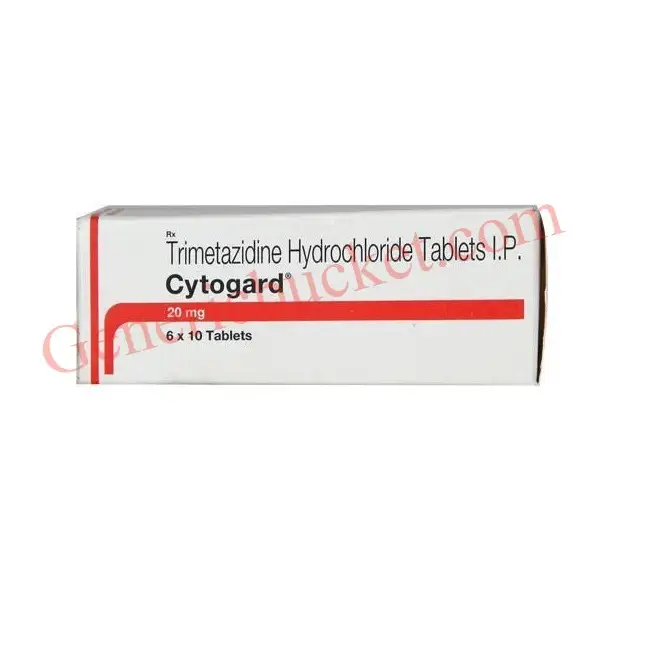

Cytogard Tablet (Trimetazidine 20mg)
Price range: $50.00 through $135.00
| Country of Origin | india |
|---|---|
| Dosage Form | Tablets |
| Equivalent Brand | Vastarel |
| Generic Name | Trimetazidine |
| Indication | Chest pain (Angina) |
| Manufacturer | Abbott India Pvt Ltd |
| Packaging | 10 tablets in 1 strip |
| Composition | Trimetazidine (20mg) |
| Cytogard Tablet (Trimetazidine 20mg) | |||
| Pack Size | Price | Price/Unit | Add To Cart |
| 50 Tablet/s | $50.00 (1/unit) | $1 | |
| 100 Tablet/s | $93.00 (0.93/unit) | $0.93 | |
| 150 Tablet/s | $135.00 (0.9/unit) | $0.9 | |
Cytogard Tablet contains trimetazidine 20 mg and is used in adults to help manage symptoms of stable angina, a type of chest pain associated with reduced blood flow to the heart. It is generally used as an add-on treatment when other anti-anginal medicines do not adequately control symptoms or are not tolerated.
It is important to understand that Cytogard Tablet does not “cure” coronary artery disease or provide emergency relief from an ongoing heart attack or sudden severe chest pain. Instead, trimetazidine supports the heart’s energy metabolism during periods when oxygen supply to the heart muscle is reduced. Because chest pain can indicate a serious cardiovascular problem, patients should use this medicine only under appropriate medical supervision.
What Is Cytogard Tablet?
Cytogard Tablet is an oral medicine containing trimetazidine 20 mg. Available product information identifies the medicine as an anti-anginal treatment used for adults with angina pectoris.
Angina occurs when the heart muscle does not receive enough oxygen-rich blood, often because the coronary arteries have narrowed. People may experience pressure, tightness, heaviness, or discomfort in the chest, sometimes spreading toward the arm, shoulder, jaw, back, or neck. Your doctor must determine the underlying cause and choose the appropriate treatment.
How Cytogard Tablet Works
Cytogard Tablet works differently from medicines that primarily lower blood pressure or directly widen coronary blood vessels. Trimetazidine acts as a metabolic agent. It helps heart cells maintain energy production when oxygen availability is limited by favoring glucose metabolism. This mechanism may help cardiac cells function more efficiently during ischemic conditions.
The medicine therefore supports symptom management rather than eliminating the underlying blockage or disease responsible for angina. Continue other prescribed cardiovascular treatments unless your clinician specifically tells you to change them.
Benefits and Uses
Doctors may prescribe Cytogard Tablet as part of a treatment plan for stable angina. The principal potential benefit is improved control of angina symptoms in appropriate patients. European regulatory guidance recommends trimetazidine as second-line, add-on therapy for stable angina when patients remain inadequately controlled or cannot tolerate first-line anti-anginal medicines.
Do not use trimetazidine for unrelated conditions simply because information online describes additional effects. The European Medicines Agency specifically restricted its authorized use because evidence did not sufficiently support its use for tinnitus, vertigo, and certain visual disturbances.
How to Take Cytogard Tablet
Take Cytogard Tablet exactly as your prescriber directs. Product information commonly recommends taking the 20 mg tablet with meals, but your individual schedule may depend on your medical condition, kidney function, age, and other medicines.
Swallow the tablet with water. Do not change the prescribed dose, take extra tablets, or discontinue treatment on your own. If you forget a dose, follow your pharmacist’s or prescriber’s instructions rather than doubling the next dose.
Your clinician may review your symptoms, kidney function, other medicines, and overall cardiovascular status during treatment.
Related Product
Side Effects
Like other medicines, Cytogard Tablet can cause unwanted effects. Reported effects include headache, dizziness, nausea, vomiting, indigestion, abdominal discomfort, diarrhea, weakness, and skin reactions.
Dizziness or drowsiness can affect your ability to drive or operate machinery. Avoid activities requiring full alertness until you know how the medicine affects you.
More importantly, trimetazidine has been associated with movement disorders, including Parkinsonian symptoms, tremor, gait problems, and restless-leg symptoms. European regulatory guidance recommends avoiding it in people with Parkinson’s disease, Parkinsonian symptoms, severe kidney impairment, or certain related movement disorders.
Contact your healthcare professional promptly if you develop new tremors, unusual movements, stiffness, difficulty walking, or significant balance problems.
Who Should Avoid or Use Extra Caution?
Tell your doctor if you have kidney disease, Parkinson’s disease, tremors, movement problems, or a history of medication allergies. Patients with moderate kidney impairment and older adults may require special consideration or dose adjustment.
Discuss pregnancy or breastfeeding with your healthcare professional before taking trimetazidine. You should also provide a complete list of prescription medicines, nonprescription medicines, and supplements so your healthcare team can evaluate your treatment safely.
Important Emergency Warning
Cytogard Tablet is not an emergency medicine for sudden chest pain. If chest pain is new, severe, prolonged, occurs at rest, or comes with shortness of breath, sweating, fainting, nausea, or pain spreading to the arm or jaw, seek emergency medical care immediately.
Do not attempt to manage potentially life-threatening chest pain by taking an additional tablet. Your emergency treatment plan should come from your healthcare professional.
Ordering and Responsible Use
When purchasing Cytogard Tablet, verify the strength, manufacturer, packaging, expiry date, and prescription requirements. Product listings identify the standard Cytogard Tablet as trimetazidine 20 mg, while Cytogard MR Tablet is a different 35 mg modified-release product; these products should not be substituted without professional advice.
For patients with a valid prescription, use a legitimate pharmacy and follow local dispensing requirements. In the United States, trimetazidine is not an FDA-approved standard treatment for angina; FDA records show trimetazidine has had orphan-drug designations but not FDA approval for those listed indications. Therefore, U.S. patients should discuss availability and appropriate alternatives with a licensed healthcare professional rather than assuming that an overseas product has U.S. approval.
Frequently Asked Questions
1. What is Cytogard Tablet used for?
Cytogard Tablet contains trimetazidine 20 mg and is used for symptomatic management of stable angina in appropriate adult patients, generally as add-on therapy.
2. Does Cytogard Tablet cure heart disease?
No. Cytogard Tablet does not cure coronary artery disease or remove blocked arteries. It may help manage angina symptoms as part of a broader treatment plan.
3. Can Cytogard Tablet stop sudden chest pain?
No. It should not replace emergency treatment for sudden or severe chest pain. Seek urgent medical attention for potentially serious cardiac symptoms.
4. What is the active ingredient?
The standard Cytogard Tablet contains trimetazidine 20 mg.
5. Can people with Parkinson’s disease take it?
Trimetazidine is contraindicated in Parkinson’s disease and Parkinsonian symptoms under European safety guidance because it can cause or worsen movement disorders. Discuss your medical history with your clinician before use.
Be the first to review “Cytogard Tablet (Trimetazidine 20mg)”
Related products

Angina Pectoris Anti-Anginals
Angina Pectoris Anti-Anginals

Angina Pectoris Anti-Anginals

Angina Pectoris Anti-Anginals

Angina Pectoris Anti-Anginals

Angina Pectoris Anti-Anginals

Angina Pectoris Anti-Anginals

Angina Pectoris Anti-Anginals

Angina Pectoris Anti-Anginals

Angina Pectoris Anti-Anginals

Angina Pectoris Anti-Anginals

Angina Pectoris Anti-Anginals
Reviews
There are no reviews yet.