
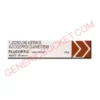

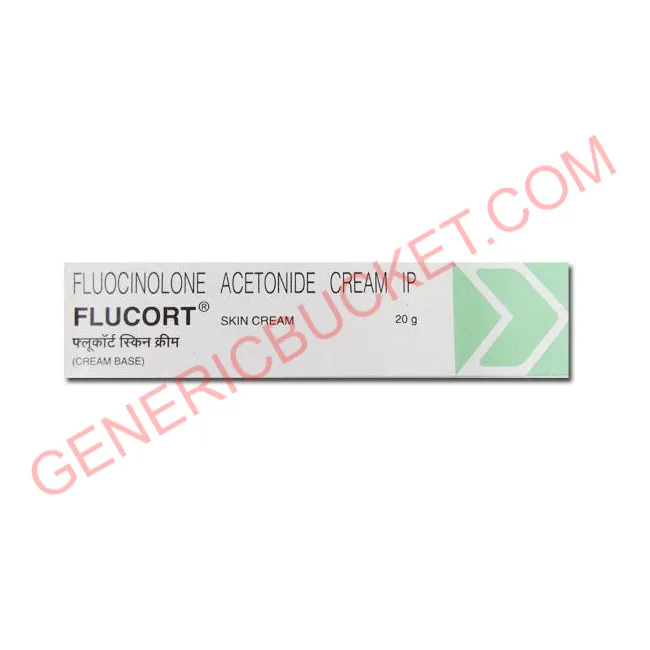

Flucort Skin Cream (Fluocinolone acetonide 0.025%)
Price range: $28.00 through $95.00
| Country of Origin | India |
|---|---|
| Dosage Form | Cream |
| Equivalent Brand | Synalar |
| Generic Name | Fluocinolone acetonide |
| Indication | Allergy symptoms, Bacterial skin infections |
| Manufacturer | Glenmark Pharmaceuticals Ltd |
| Packaging | 20 gm in 1 tube |
| Composition | Fluocinolone acetonide (0.025% w/w) |
| Pack Size | 3 Tube/s, 6 Tube/s, 12 Tube/s |
| Flucort Skin Cream (Fluocinolone acetonide 0.025%) | |||
| Pack Size | Price | Price/Unit | Add To Cart |
| 3 Tube/s | $28.00 (9.33/unit) | $9.33 | |
| 6 Tube/s | $52.00 (8.67/unit) | $8.67 | |
| 12 Tube/s | $95.00 (7.92/unit) | $7.92 | |
Flucort Skin Cream is a topical corticosteroid medicine used to relieve inflammation, redness, swelling, itching, and irritation associated with certain corticosteroid-responsive skin conditions. The product contains fluocinolone acetonide, a corticosteroid that helps reduce the inflammatory response in the skin. Available product information identifies the commonly marketed Flucort Skin Cream strength as fluocinolone acetonide 0.025% w/w.
Skin inflammation can cause considerable discomfort. Persistent itching may lead to scratching, while redness, scaling, and irritation can make everyday activities uncomfortable. Flucort Skin Cream works by reducing the release and activity of inflammatory substances responsible for these symptoms. This action can help calm irritated skin and improve symptoms when the underlying condition responds appropriately to topical corticosteroid treatment.
What Is Flucort Skin Cream Used For?
Doctors may prescribe Flucort Skin Cream for inflammatory skin disorders such as eczema, dermatitis, psoriasis, and other corticosteroid-responsive dermatoses. Depending on the individual diagnosis, it may help reduce itching, redness, swelling, irritation, and scaling. Some product references also describe its use for seborrheic dermatitis.
The medicine does not treat every cause of a rash. For example, fungal, viral, or bacterial infections may require different treatment. A corticosteroid can sometimes mask or worsen an untreated infection, so you should obtain an appropriate diagnosis before using a steroid cream for an unexplained rash. If the treated area becomes increasingly painful, develops pus, spreads rapidly, or appears infected, contact a healthcare professional promptly.
How Does Flucort Skin Cream Work?
Flucort Skin Cream contains fluocinolone acetonide, which belongs to the corticosteroid class. It reduces inflammatory activity in the skin and decreases the release of substances that contribute to redness, swelling, and itching. By controlling this inflammatory response, the medicine can provide symptomatic relief while the skin heals.
The response varies between individuals and depends on the condition being treated, its severity, the body area involved, and how consistently the medicine is used. Some people may notice improvement relatively quickly, while others require several days of appropriate treatment before they experience substantial relief.
How to Apply Flucort Skin Cream
Use Flucort Skin Cream exactly according to your prescriber’s instructions. Before application, gently clean and dry the affected area. Apply a thin layer to the affected skin and spread it gently. Wash your hands after application unless your hands are the area being treated. Avoid applying more medicine than directed because excessive topical corticosteroid exposure can increase the likelihood of adverse effects.
Do not place an airtight dressing, plastic covering, or tight bandage over the treated area unless your healthcare professional specifically instructs you to do so. Occlusion can increase corticosteroid absorption and may increase the risk of local or systemic adverse effects. Keep the cream away from the eyes, mouth, nose, and other mucous membranes. If accidental contact occurs, rinse thoroughly with water.
Related product
Important Safety Information
Because Flucort Skin Cream is a corticosteroid, use it only for the condition and body area recommended by your healthcare professional. Avoid prolonged or unnecessary use. Topical corticosteroids can cause skin thinning and other local changes, particularly when used for extended periods, on sensitive areas, or under occlusive dressings. Report unusual or persistent skin changes to your healthcare professional.
Do not automatically use this product for acne, an undiagnosed rash, or a suspected skin infection. Children may be more susceptible to corticosteroid-related effects, so pediatric use should follow a clinician’s instructions. Discuss pregnancy or breastfeeding with your healthcare professional before using a corticosteroid medicine.
If your symptoms do not improve as expected, become worse, or repeatedly return, seek medical advice rather than continuing treatment on your own. Your clinician may need to reassess the diagnosis or change the treatment plan.
Possible Side Effects
Some people may experience temporary application-site reactions after using Flucort Skin Cream. Reported effects can include burning, itching, irritation, redness, dryness, acne-like eruptions, or inflammation around hair follicles.
Longer or inappropriate corticosteroid use can produce more significant skin changes, including thinning of the skin, stretch marks, changes in pigmentation, and increased susceptibility to secondary infections. These risks make correct dosing, appropriate treatment duration, and professional supervision important.
Stop self-treatment and contact a healthcare professional if the skin condition becomes significantly worse, develops signs of infection, or produces a concerning reaction.
Storage and Handling
Keep the tube tightly closed and store it according to the product label. One current product reference recommends storage below 25°C. Keep medicines away from excessive heat, moisture, and direct sunlight, and keep them out of children’s reach.
Who Should Use Flucort Skin Cream?
The appropriate candidate depends on the diagnosis and medical history. Flucort Skin Cream is intended for external topical use and should be used when a healthcare professional determines that a corticosteroid is appropriate. Tell your clinician about other medicines, existing skin infections, allergies, pregnancy, breastfeeding, and previous reactions to topical corticosteroids.
For customers seeking to obtain this prescription medicine, verify the exact strength, formulation, and prescription requirements with a licensed pharmacy before placing an order. Do not substitute Flucort, Flucort-H, or Flucort-N products because similarly named products can contain different ingredients and strengths.
Frequently Asked Questions
1. What is Flucort Skin Cream?
Flucort Skin Cream is a topical corticosteroid containing fluocinolone acetonide. It is used to reduce inflammation and itching associated with certain responsive skin disorders.
2. Can Flucort Skin Cream treat eczema?
It may help relieve inflammation, redness, and itching associated with eczema when the condition is appropriate for topical corticosteroid treatment. Use it according to your clinician’s directions.
3. Can I use Flucort Skin Cream for any rash?
No. Not every rash responds to corticosteroids. Some rashes result from infections or other conditions requiring different treatment. Obtain an appropriate diagnosis before treating an unexplained rash.
4. Can I use Flucort Skin Cream on my face?
Facial skin is particularly sensitive to corticosteroids. Do not apply it to your face unless your healthcare professional specifically recommends it and provides appropriate instructions.
5. What happens if I use too much?
Using excessive amounts or using the medicine for longer than directed can increase the risk of skin thinning and other corticosteroid-related effects. Contact your healthcare professional if you have concerns about excessive use.
Be the first to review “Flucort Skin Cream (Fluocinolone acetonide 0.025%)”
Related products

Allergy



Reviews
There are no reviews yet.