

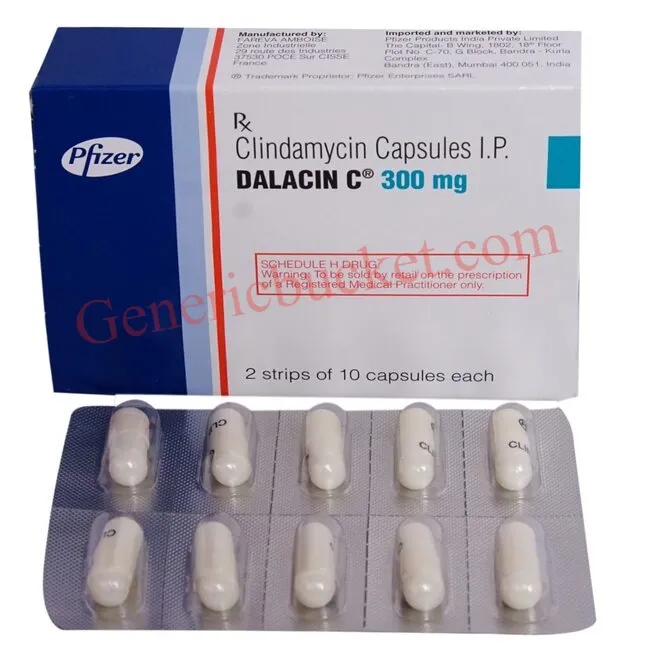

Dalacin C 300mg Capsule (Clindamycin 300mg)
Price range: $59.00 through $150.00
| Country of Origin | india |
|---|---|
| Dosage Form | Capsules |
| Equivalent Brand | Cleocin |
| Generic Name | Clindamycin |
| Indication | Bacterial infection |
| Manufacturer | Pfizer India Ltd |
| Packaging | 10 capsules in 1 strip |
| Composition | Clindamycin (300mg) |
| Dalacin C 300mg Capsule (Clindamycin 300mg) | |||
| Pack Size | Price | Price/Unit | Add To Cart |
| 50 Capsule/s | $59.00 (1.18/unit) | $1.18 | |
| 100 Capsule/s | $108.00 (1.08/unit) | $1.08 | |
| 150 Capsule/s | $150.00 (1/unit) | $1 | |
Dalacin C 300mg Capsule contains clindamycin, a lincosamide antibiotic used to treat certain serious bacterial infections caused by susceptible bacteria. It does not treat viral illnesses such as the common cold or influenza. Clindamycin capsules should be used only when a bacterial infection is proven or strongly suspected and when the medicine is appropriate for the individual patient. The U.S. FDA labeling also carries a prominent warning about potentially severe Clostridioides difficile-associated diarrhea and colitis.
What Is Dalacin C 300mg Capsule?
Dalacin C 300mg Capsule is an oral antibiotic formulation containing clindamycin hydrochloride equivalent to 300 mg of clindamycin. Clindamycin works by binding to the 50S subunit of bacterial ribosomes and inhibiting bacterial protein synthesis. This prevents susceptible bacteria from producing proteins necessary for growth and survival.
The brand name Dalacin C is associated with clindamycin products. Current UK medicines information lists Dalacin C capsules in 75 mg and 150 mg strengths, while 300 mg clindamycin hard capsules are also available from other manufacturers. Therefore, patients should check the exact product, strength, manufacturer, and prescription supplied to them rather than assuming that every 300 mg capsule carries the Dalacin C brand.
Uses of Dalacin C 300mg Capsule
Doctors may prescribe Dalacin C 300mg Capsule or another equivalent clindamycin 300 mg capsule for selected bacterial infections involving susceptible organisms. Depending on the infection and susceptibility testing, clindamycin can be used for certain serious infections caused by susceptible gram-positive bacteria and anaerobic bacteria. Examples can include some skin and soft-tissue infections and certain anaerobic infections.
The medicine does not provide a general “cure” for every infection. Your clinician must determine whether bacteria are responsible for your symptoms and whether clindamycin is an appropriate antibiotic. Using antibiotics unnecessarily can contribute to antimicrobial resistance, so patients should not use leftover capsules or share antibiotics with another person.
How Does Dalacin C 300mg Capsule Work?
After you take the capsule, clindamycin is absorbed and distributed throughout the body. It reaches susceptible bacteria and interferes with their ability to manufacture proteins. By disrupting bacterial protein production, clindamycin suppresses bacterial growth and helps the immune system control the infection.
Your response depends on factors such as the type of infection, the bacteria causing it, antibiotic susceptibility, the site of infection, and your overall health. You should therefore follow the prescribed regimen rather than changing the dose according to how quickly your symptoms improve.
How to Take Dalacin C 300mg Capsule
Take Dalacin C 300mg Capsule exactly as your prescriber directs. Swallow the capsule whole with a full glass of water. Do not crush or chew the capsule unless a healthcare professional specifically tells you otherwise. Product information for oral clindamycin recommends taking capsules with plenty of water and remaining upright for at least 30 minutes afterward to reduce the possibility of irritation of the esophagus.
Do not stop treatment early simply because you feel better. If you miss a dose, follow the instructions provided with your prescription or contact your pharmacist for advice. Never take extra capsules to compensate for a missed dose unless your healthcare professional specifically instructs you to do so.
The appropriate dose and treatment duration vary considerably according to the infection, its severity, the patient’s age and other clinical factors. Some adult product information describes different dosing ranges for moderately severe and severe infections, which demonstrates why patients should not self-select a clindamycin dose.
Related Product
Common Side Effects
Like all medicines, Dalacin C 300mg Capsule may cause side effects. Common gastrointestinal effects can include nausea, abdominal discomfort, vomiting, and diarrhea. Some patients may also develop skin reactions or other adverse effects.
Diarrhea deserves particular attention when taking clindamycin. Antibiotic-associated diarrhea can sometimes indicate C. difficile infection, which can become severe and may occur during treatment or even weeks afterward. The FDA specifically warns that clindamycin has been associated with severe, potentially life-threatening colitis.
Contact a healthcare professional promptly if you develop severe, persistent, or bloody diarrhea, significant abdominal cramping, fever, or other concerning gastrointestinal symptoms during or after treatment.
Important Safety Information
Do not take Dalacin C 300mg Capsule if you have previously experienced a serious allergic reaction to clindamycin or lincomycin, or if your prescriber has identified another contraindication. Tell your doctor about previous antibiotic-associated colitis or significant gastrointestinal disease before starting treatment.
Seek urgent medical attention for signs of a serious allergic reaction, including difficulty breathing, facial or throat swelling, widespread blistering or peeling skin, or a rapidly developing severe rash. Serious hypersensitivity reactions, including Stevens-Johnson syndrome, toxic epidermal necrolysis, and DRESS, have been reported with clindamycin.
Tell your healthcare professional about all prescription medicines, over-the-counter products, and supplements you use. This helps your clinician assess potential interactions and determine whether clindamycin is suitable for you.
Who Should Use This Medicine?
Dalacin C 300mg Capsule should be used only by the person for whom a qualified healthcare professional prescribed it. It is not appropriate for treating viral infections, and purchasing antibiotics for self-treatment can delay correct diagnosis and increase the risk of antibiotic resistance.
Children require weight-based dosing and an age-appropriate formulation. Capsules may not be suitable for children who cannot safely swallow them.
Pregnant or breastfeeding patients should discuss clindamycin use with their healthcare professional before treatment. Your clinician can assess the benefits and potential risks based on your individual circumstances.
Why Proper Antibiotic Use Matters
Responsible use of Dalacin C 300mg Capsule helps protect both your health and the effectiveness of antibiotics. Take the medicine only for the infection for which it was prescribed, follow the prescribed schedule, and never use an old prescription for a new illness.
If symptoms do not improve, become worse, or return after treatment, contact your healthcare professional rather than automatically restarting clindamycin. A different diagnosis, resistant bacteria, or another treatment may be responsible.
Frequently Asked Questions
Is Dalacin C 300mg Capsule an antibiotic?
Yes. It contains clindamycin, a lincosamide antibacterial medicine used against susceptible bacterial infections.
Does Dalacin C 300mg Capsule treat viral infections?
No. Clindamycin does not treat viral illnesses such as colds or influenza. It should be reserved for appropriate bacterial infections.
Can I stop Dalacin C 300mg Capsule when I feel better?
Do not stop or alter your prescribed course without speaking with your healthcare professional. Follow the treatment duration provided on your prescription.
Can this medicine cause diarrhea?
Yes. Diarrhea can occur with clindamycin. Severe or persistent diarrhea, particularly if accompanied by abdominal pain, fever, or blood, requires prompt medical evaluation because C. difficile-associated colitis can occur with antibiotic treatment.
Can I take the capsule with food?
Clindamycin absorption is not substantially changed by food according to product information. Taking the capsule with a full glass of water and remaining upright afterward is important.
Be the first to review “Dalacin C 300mg Capsule (Clindamycin 300mg)”
Related products




Acne



Reviews
There are no reviews yet.