
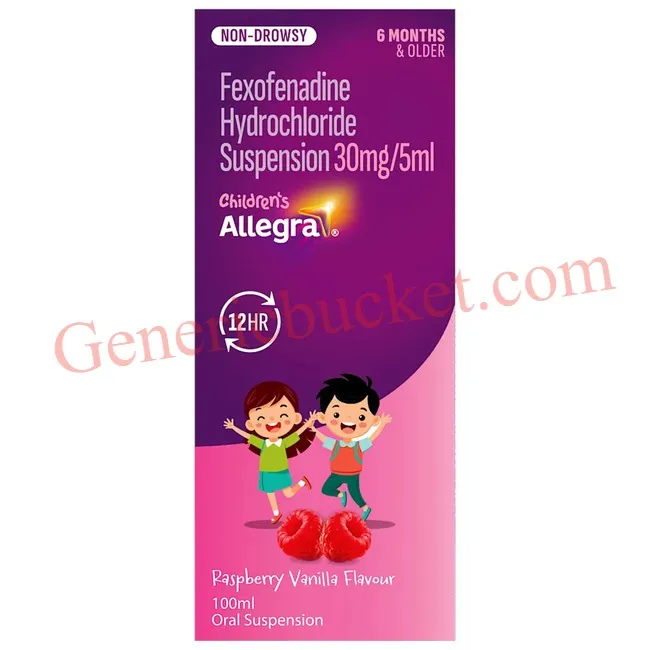

Allegra Suspension (Fexofenadine 30mg)
Price range: $30.00 through $130.00
| Country of Origin | india |
|---|---|
| Dosage Form | suspension |
| Generic Name | Fexofenadine |
| Indication | Treatment of Allergic conditions |
| Packaging | 100 ml in 1 bottle |
| Manufacturer | Sanofi India Ltd |
| Composition | Fexofenadine (30mg/5ml) |
| Allegra Suspension (Fexofenadine 30mg) | |||
| Pack Size | Price | Price/Unit | Add To Cart |
| 1 Bottle/s | $30.00 (30/unit) | $30 | |
| 3 Bottle/s | $72.00 (24/unit) | $24 | |
| 6 Bottle/s | $130.00 (21.67/unit) | $21.67 | |
Allegra Suspension contains fexofenadine hydrochloride, an antihistamine that helps relieve certain allergy symptoms. Depending on the specific formulation, fexofenadine suspension may be used for hay fever and other upper-respiratory allergy symptoms or for uncomplicated skin manifestations of chronic idiopathic urticaria (hives). The exact indication, age range, and dose depend on the product label and the patient’s age and medical condition.
What Is Allegra Suspension?
Allegra Suspension is a liquid oral medicine containing fexofenadine hydrochloride. The suspension formulation can make administration easier for children who have difficulty swallowing tablets. A commonly labeled concentration is 30 mg of fexofenadine hydrochloride in each 5 mL. However, patients should always check the strength printed on their specific bottle because formulations and labeling can differ.
Fexofenadine belongs to the antihistamine class. It works by blocking the effects of histamine, a chemical involved in many allergic symptoms. By reducing histamine activity, the medicine can help control symptoms such as sneezing, a runny nose, itchy or watery eyes, and itching of the nose or throat when the product is labeled for upper-respiratory allergies.
What Does Allegra Suspension Treat?
Allegra Suspension does not cure the underlying tendency to develop allergies, but it can temporarily relieve symptoms associated with allergic conditions. For Children’s Allegra Allergy suspension, the U.S. OTC labeling lists temporary relief of runny nose, sneezing, itchy or watery eyes, and itching of the nose or throat caused by hay fever or other upper-respiratory allergies.
A separate prescription formulation of Allegra oral suspension has been labeled for uncomplicated skin manifestations of chronic idiopathic urticaria in children 6 months through 6 years of age. That formulation has specific pediatric dosing instructions and should be used according to the prescribing information provided by the healthcare professional.
Because different fexofenadine suspensions may carry different directions, parents and caregivers should not assume that one product’s dosage applies to another. Always identify the exact strength and indication before administering the medicine.
How to Use Allegra Suspension
Shake the bottle well if the product label instructs you to do so, and measure each dose with the supplied dosing device or another appropriate medication-measuring device. Do not estimate a liquid dose with an ordinary kitchen spoon because household spoons can hold different amounts.
Follow the package directions or the healthcare professional’s instructions carefully. Never give more medicine than directed. For the prescription Allegra oral suspension labeled for chronic idiopathic urticaria, the FDA labeling lists 30 mg twice daily for children ages 2 to 6 years and 15 mg twice daily for children 6 months to less than 2 years. Children with decreased kidney function require different administration instructions.
For OTC Children’s Allegra Allergy suspension, follow the current package directions for the child’s age and the exact product purchased. Do not substitute dosing instructions from another fexofenadine product.
Related product
Important Safety Information
Before using Allegra Suspension, check whether the child has previously experienced an allergic reaction to fexofenadine or any ingredient in the product. The labeling advises people with kidney disease to consult a doctor because a different dose may be necessary.
Fexofenadine products should not be taken at the same time as aluminum- or magnesium-containing antacids because these products can interfere with absorption. The prescription suspension labeling also instructs patients to take the medicine with water rather than fruit juice.
Parents should seek urgent medical attention when a child develops signs of a severe allergic reaction, such as significant swelling of the tongue or mouth, difficulty swallowing, wheezing, trouble breathing, severe dizziness, or loss of consciousness. An antihistamine should not replace prescribed emergency treatment such as epinephrine when epinephrine has been prescribed for anaphylaxis.
Possible Side Effects
Like other medicines, Allegra Suspension can cause side effects. The reported reactions vary according to age and formulation. The prescription oral suspension labeling reports vomiting, diarrhea, fatigue or somnolence, and runny nose among more frequently reported reactions in young children. Older children and adults may experience other reactions, including headache or dizziness.
Contact a healthcare professional if side effects become persistent, severe, or concerning. Stop the medicine and seek medical advice if an allergic reaction to the medicine itself occurs.
Why Choose Allegra Suspension?
One practical advantage of Allegra Suspension is its liquid dosage form. Children who cannot comfortably swallow tablets may find a measured liquid easier to take. Fexofenadine is also considered a relatively non-sedating antihistamine, although individual responses can vary.
The medicine can provide useful symptom relief when used for an appropriate allergy-related condition. However, it should not be promoted as a cure for every type of allergy, infection, cold, or breathing problem. Correct diagnosis and age-appropriate dosing remain important.
Storage and Handling
Store Allegra Suspension according to the instructions printed on the specific product label. Keep the bottle securely closed and out of children’s reach. Do not use a product after its expiration date, and do not use it if the packaging or seal appears damaged.
When purchasing medication online, choose a properly licensed pharmacy and verify the product name, active ingredient, strength, expiration date, and packaging before use. A pharmacist can also help confirm whether the selected suspension is appropriate for the intended patient.
Frequently Asked Questions
Is Allegra Suspension an antihistamine?
Yes. Allegra Suspension contains fexofenadine hydrochloride, an H1-receptor antagonist used to reduce symptoms associated with certain allergic conditions.
Can children take Allegra Suspension?
Some fexofenadine suspension products are specifically labeled for children. The appropriate age, indication, strength, and dose depend on the exact formulation, so parents should follow the product label or their child’s healthcare professional’s instructions.
Does Allegra Suspension cause drowsiness?
Fexofenadine is generally considered less sedating than many older antihistamines, but individual reactions can vary. Parents should observe the child when using any new medicine.
Can I give fruit juice with Allegra Suspension?
The FDA labeling for prescription Allegra oral suspension instructs patients to take it with water rather than fruit juice. Follow the directions for your exact formulation.
Can I take an antacid with Allegra Suspension?
Aluminum- or magnesium-containing antacids should not be taken at the same time because they can interfere with fexofenadine absorption. Ask a pharmacist about appropriate timing.
Be the first to review “Allegra Suspension (Fexofenadine 30mg)”
Related products


Allergy







Reviews
There are no reviews yet.