

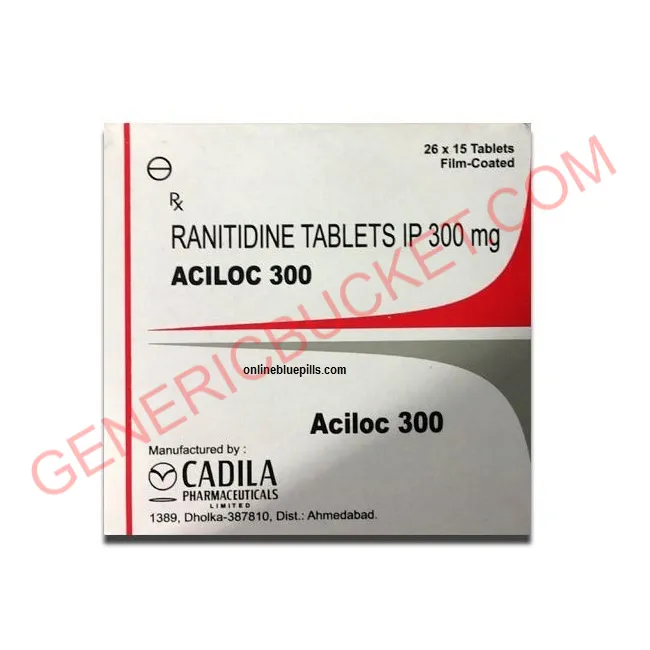

Aciloc 300mg Tablet (Ranitidine 300mg )
Price range: $45.00 through $114.00
| Country of Origin | india |
|---|---|
| Dosage Form | Tablets |
| Equivalent Brand | Zantac |
| Generic Name | Ranitidine |
| Indication | Acidity, Heartburn, Stomach ulcers |
| Manufacturer | Cadila Pharmaceuticals Ltd |
| Packaging | 30 tablets in 1 strip |
| Composition | Ranitidine (300mg) |
| Aciloc 300mg Tablet (Ranitidine 300mg ) | |||
| Pack Size | Price | Price/Unit | Add To Cart |
| 180 Tablet/s | $45.00 (0.25/unit) | $0.25 | |
| 360 Tablet/s | $83.00 (0.23/unit) | $0.23 | |
| 540 Tablet/s | $114.00 (0.21/unit) | $0.21 | |
Aciloc 300mg Tablet contains ranitidine 300 mg and belongs to a class of medicines called histamine-2 (H2) receptor antagonists. It reduces the amount of acid produced in the stomach and has historically been used for conditions such as heartburn, acid reflux, indigestion, and certain peptic ulcers. Product information for Aciloc 300 mg identifies ranitidine 300 mg as its active ingredient. If you are considering this medicine, use it only when an appropriate healthcare professional confirms that the specific product and formulation are suitable for you.
What Is Aciloc 300mg Tablet?
Aciloc 300mg Tablet is an acid-reducing medicine containing ranitidine. Excess stomach acid can irritate the lining of the stomach and esophagus and contribute to symptoms such as burning in the chest, sour regurgitation, upper abdominal discomfort, and indigestion. Ranitidine works by blocking histamine H2 receptors on acid-producing cells in the stomach. This action decreases gastric acid secretion and can help relieve acid-related symptoms.
The medicine does not simply neutralize acid that already exists in the stomach. Instead, it reduces new acid production. This mechanism makes H2 blockers different from conventional antacids, which primarily neutralize existing stomach acid.
What Is Aciloc 300mg Tablet Used For?
Doctors have historically prescribed Aciloc 300mg Tablet for several acid-related gastrointestinal conditions. These include heartburn, hyperacidity, dyspepsia, gastroesophageal reflux disease (GERD), and peptic ulcer disease. Official product information for Aciloc 300 mg in Singapore lists short-term relief of heartburn, dyspepsia, and hyperacidity among its indications.
Treatment depends on the underlying condition. Occasional heartburn may require a different approach from a confirmed stomach ulcer or persistent reflux. Therefore, do not assume that every episode of acidity requires a 300 mg dose.
How Does Ranitidine Work?
Ranitidine blocks H2 receptors in the stomach. Normally, stimulation of these receptors encourages stomach cells to release hydrochloric acid. By reducing this stimulation, ranitidine lowers gastric acid production.
Lower acid levels can give irritated tissues an opportunity to recover and can reduce symptoms associated with acid reflux. However, the medicine does not treat every possible cause of abdominal pain, nausea, or indigestion. Symptoms that continue despite treatment require medical evaluation.
How to Take Aciloc 300mg Tablet
Take Aciloc 300mg Tablet exactly according to the instructions provided by your prescriber or pharmacist. Do not increase the dose, take extra tablets, or continue treatment longer than recommended simply because symptoms remain.
Swallow the tablet with water unless your healthcare professional gives you different instructions. The appropriate dose and duration depend on your diagnosis, age, kidney function, other medicines, and individual health circumstances.
The Singapore National Drug Formulary currently lists Aciloc 300 mg as a prescription-only medicine and specifies a maximum daily dose of 300 mg for the listed short-term indications. Your own prescription should always take priority over general product information.
Related Product
Important Safety Information
Ranitidine has an important regulatory history. In 2020, concerns about the impurity NDMA led to withdrawal of ranitidine products from the U.S. market. The FDA subsequently approved a reformulated ranitidine product in November 2025 after safety testing and manufacturing changes designed to address previous NDMA formation concerns.
This distinction matters: an older ranitidine product should not automatically be treated as equivalent to a newly approved reformulated product. The FDA specifically advises attention to updated labeling, storage, and handling requirements for approved reformulated ranitidine.
Because Aciloc 300 mg is identified as a ranitidine product manufactured by Cadila Pharmaceuticals in India, patients should verify the product’s current regulatory status, source, batch information, and prescribing instructions before use.
Possible Side Effects
Like other medicines, Aciloc 300mg Tablet may cause unwanted effects. Possible symptoms can include headache, nausea, abdominal discomfort, diarrhea, constipation, or dizziness. Not everyone experiences side effects.
Seek medical attention if you develop a severe allergic reaction, significant confusion, unusual changes in heartbeat, severe abdominal symptoms, or another concerning reaction. Do not ignore persistent digestive symptoms simply by continuing acid-reducing medication.
Who Should Use Extra Caution?
Tell your healthcare professional if you have kidney or liver problems, a history of gastrointestinal bleeding, difficulty swallowing, unexplained weight loss, recurrent vomiting, or persistent abdominal pain.
You should also provide a complete list of prescription medicines, over-the-counter products, vitamins, and supplements you take. Acid-reducing medicines can affect the absorption or handling of certain medicines, so professional review can help prevent avoidable interactions.
Pregnant or breastfeeding patients should discuss ranitidine use with a healthcare professional before taking it.
Aciloc 300mg Tablet and Lifestyle Measures
Medication can help manage acid-related symptoms, but lifestyle measures may also improve control. Avoid foods and beverages that consistently trigger your symptoms. Eating smaller meals, avoiding meals immediately before lying down, maintaining a healthy weight when appropriate, and limiting smoking and alcohol can help some people with reflux symptoms.
Do not rely on long-term self-treatment for recurring heartburn. Frequent symptoms may indicate GERD or another condition requiring evaluation.
Frequently Asked Questions
Is Aciloc 300mg Tablet an antacid?
No. Aciloc 300mg Tablet contains ranitidine, an H2 receptor antagonist. It reduces stomach acid production rather than simply neutralizing acid already present.
Can Aciloc 300mg Tablet cure acidity permanently?
It can reduce acid-related symptoms and may support healing of certain acid-related conditions when appropriately prescribed, but it does not permanently cure every cause of acidity. Persistent symptoms need medical assessment.
Can I take Aciloc 300mg Tablet every day?
Only take it as long and at the dose prescribed by your healthcare professional. Long-term or repeated self-treatment is not appropriate without determining the cause of recurring symptoms.
What is the active ingredient in Aciloc 300mg Tablet?
The listed active ingredient is ranitidine 300 mg.
Is Aciloc 300mg Tablet available in the United States?
Aciloc is a brand associated with products marketed outside the United States. U.S. availability and labeling should not be assumed from the Indian Aciloc product. The FDA approved reformulated ranitidine products in the U.S. in November 2025.
Be the first to review “Aciloc 300mg Tablet (Ranitidine 300mg )”
Related products
Acid Reducers
Acid Reducers

Acid Reducers
Acid Reducers
Acid Reducers

Acid Reducers

Acid Reducers
Acid Reducers

Acid Reducers

Acid Reducers
Acid Reducers
Reviews
There are no reviews yet.