

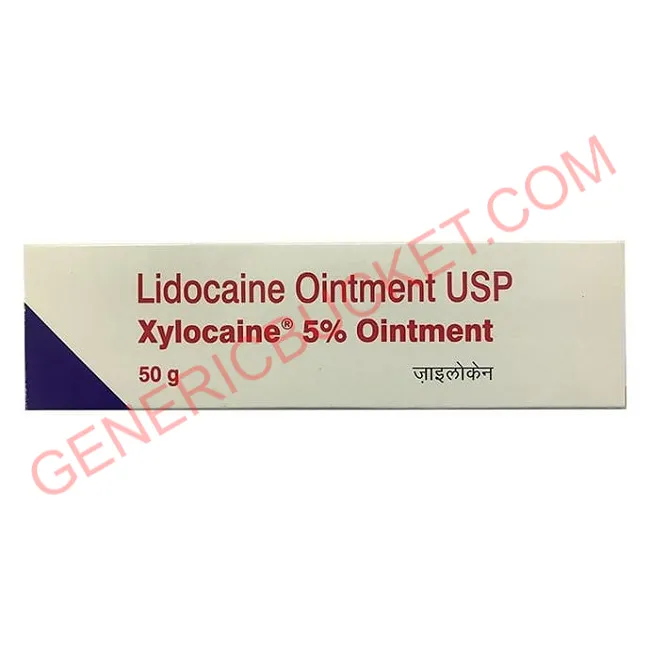

Xylocaine 5% Ointment (Lidocaine 5%)
Price range: $30.00 through $80.00
| Active Ingredient (Generic Name): | Lidocaine |
|---|---|
| Indication: | Local Anaesthesia |
| Manufacturer: | German Remedies Private Ltd |
| Packaging: | 30 gm in 1 pack |
| Strength | 5% |
| Pack Size | 3 Ointment/s, 6 Ointment/s, 9 Ointment/s |
| Xylocaine 5% Ointment (Lidocaine 5%) | |||
| Pack Size | Price | Price/Unit | Add To Cart |
| 3 Ointment/s | $30.00 (10/unit) | $10 | |
| 6 Ointment/s | $56.00 (9.33/unit) | $9.33 | |
| 9 Ointment/s | $80.00 (8.89/unit) | $8.89 | |
Xylocaine 5% Ointment contains lidocaine, a local anesthetic that temporarily reduces sensation in the area where it is applied. It works by blocking nerve signals responsible for pain and other sensations, making it useful when localized anesthesia or temporary relief from certain minor painful conditions is needed. Prescription-strength lidocaine ointment should be used according to the directions provided by a healthcare professional or the product labeling.
What Is Xylocaine 5% Ointment?
Xylocaine 5% Ointment is a topical preparation containing 5% lidocaine. Lidocaine belongs to the amide group of local anesthetics. Rather than treating the underlying cause of an injury or disease, it temporarily decreases sensation by interfering with the nerve impulses that transmit pain. This makes the medicine useful when a healthcare professional wants localized topical anesthesia or when the labeled product is appropriate for temporary relief of certain minor painful skin conditions.
Each gram of a typical lidocaine 5% ointment contains 50 mg of lidocaine. Formulations can contain different inactive ingredients depending on the manufacturer, so patients should check the specific package supplied to them.
How Does Xylocaine 5% Ointment Work?
The active ingredient, lidocaine, stabilizes nerve-cell membranes and inhibits the ionic changes required for the initiation and conduction of nerve impulses. As a result, the treated area becomes temporarily less sensitive. Some labeled lidocaine 5% ointment products describe topical anesthesia beginning within approximately 3 to 5 minutes, although the response can vary according to the application site, condition of the tissue, amount used, and individual patient factors.
Because this medicine acts locally, it does not cure an underlying infection, inflammation, wound, or other medical condition. Instead, it provides temporary numbing or pain relief while the underlying problem receives appropriate care.
Uses and Potential Benefits
Depending on the specific product labeling and the healthcare professional’s instructions, lidocaine 5% ointment can provide local anesthesia of accessible mucous membranes and may also be used as an anesthetic lubricant for certain medical procedures. Some labeled formulations also describe temporary relief of pain associated with minor burns, including sunburn, abrasions, and insect bites.
The main benefit is localized action. Instead of producing whole-body anesthesia, lidocaine works primarily at the application site. This can help reduce uncomfortable sensations and make certain minor procedures or painful areas easier to manage when the medicine is used appropriately.
How to Use Xylocaine 5% Ointment
Use Xylocaine 5% Ointment exactly as prescribed or directed on the applicable product label. Apply only the recommended amount to the intended area. Do not apply more frequently than instructed. Using excessive quantities or applying doses too close together can increase blood levels of lidocaine and may cause serious systemic adverse effects.
This product is intended for topical use. Avoid getting it into the eyes. Do not use it on areas for which your healthcare professional has not recommended it. If you have questions about whether the ointment is appropriate for a particular wound, mucosal surface, burn, or procedure, ask your pharmacist or prescriber before applying it.
Related Product
Important Safety Information
Although topical application may seem simple, lidocaine can cause serious toxicity when too much enters the bloodstream. Follow dosing instructions carefully, particularly when applying the medicine to damaged tissue, mucous membranes, or large areas. Patients should also avoid combining multiple lidocaine-containing products unless a healthcare professional specifically recommends doing so, because the effects of local anesthetics can be additive.
Do not use lidocaine ointment if you have a known hypersensitivity to amide-type local anesthetics or any ingredient in the specific formulation. Seek medical attention for unusual symptoms such as severe dizziness, confusion, seizures, breathing difficulties, significant cardiovascular symptoms, or signs suggestive of methemoglobinemia, such as unusual gray or blue coloration of the skin or lips. Local anesthetics have been associated with methemoglobinemia, a potentially serious condition that requires prompt medical evaluation.
Who Should Take Extra Care?
Tell your healthcare professional about all medicines and local anesthetics you use. Patients with significant liver impairment may require additional caution because lidocaine metabolism can be affected. Children, older adults, and people with serious medical conditions may also require individualized dosing or monitoring.
Pregnant or breastfeeding patients should discuss the medicine with their healthcare professional before use. Never assume that a topical medicine is automatically risk-free simply because it is applied to the skin or mucosa.
Why Choose This Topical Anesthetic?
When appropriately prescribed, Xylocaine 5% Ointment offers a convenient topical method for temporarily reducing sensation at a specific treatment site. Its active ingredient has an established local anesthetic mechanism, and lidocaine 5% ointment is available in prescription formulations in the United States.
For the best results, use the product exactly as directed rather than applying extra ointment to obtain stronger or faster relief. More medicine does not necessarily mean better relief and can increase the risk of toxicity.
Ordering and Pharmacist Guidance
Before ordering Xylocaine 5% Ointment, confirm that the product, strength, formulation, and directions match your prescription or healthcare professional’s recommendation. Because different lidocaine products can have different approved uses and instructions, consumers should not substitute one formulation for another without professional advice.
If this medicine has been prescribed for you, keep it stored according to the specific package instructions and keep it away from children. Current U.S. labeling for some lidocaine 5% ointment products recommends controlled room-temperature storage around 20–25°C (68–77°F), with permitted excursions depending on the product. Always follow the storage instructions printed on your own package.
Order only from a legitimate pharmacy and use this medicine according to your prescription. If you are unsure whether this topical anesthetic is appropriate for your symptoms, speak with a licensed pharmacist or healthcare professional before placing an order.
Common FAQs
1. What is Xylocaine 5% Ointment used for?
Xylocaine 5% Ointment contains lidocaine and provides temporary local anesthesia. Depending on the specific labeling, lidocaine 5% ointment may be used for anesthesia of accessible mucous membranes, as an anesthetic lubricant for certain procedures, and for temporary relief associated with minor burns, abrasions, and insect bites.
2. Does Xylocaine 5% Ointment cure pain?
No. It temporarily reduces the sensation of pain by numbing the application area. It does not necessarily treat or cure the underlying condition causing the pain.
3. How quickly does lidocaine ointment work?
Some labeled lidocaine 5% ointment products report an onset of topical anesthesia within about 3–5 minutes. Individual results can vary.
4. Can I apply Xylocaine 5% Ointment to my eyes?
No. Lidocaine 5% ointment labeling specifically warns against use in the eyes.
5. Can I use more ointment if my pain continues?
Do not increase the amount or frequency on your own. Excessive dosing or short intervals between applications can increase systemic lidocaine exposure and the risk of serious adverse effects. Contact your healthcare professional if the prescribed amount does not provide adequate relief.
Be the first to review “Xylocaine 5% Ointment (Lidocaine 5%)”
Related products

Anti Cancer

Anti Cancer
Anti Cancer
Anti Cancer

Anti Cancer

Anti Cancer

Anti Cancer

Anti Cancer
Anti Cancer

Anti Cancer

Anti Cancer
Anti Cancer
Reviews
There are no reviews yet.