
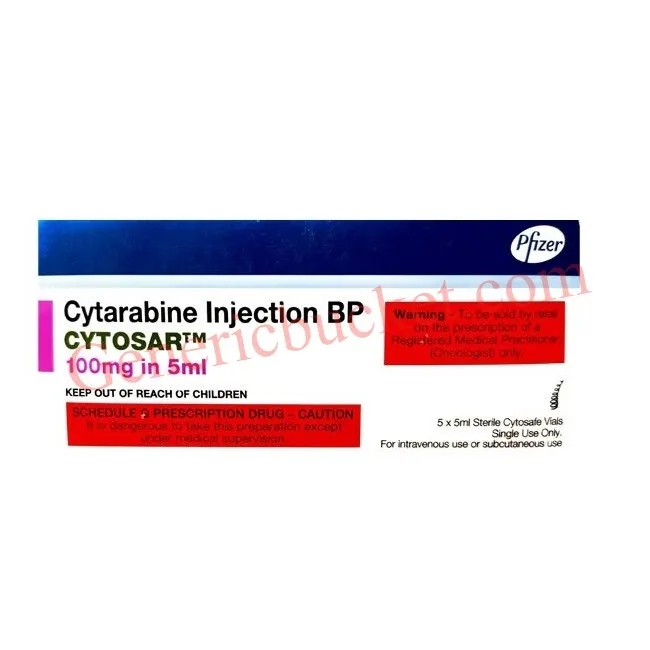

Cytosar 100mg Injection (Cytarabine 100mg)
Price range: $44.00 through $156.00
| Country of Origin | india |
|---|---|
| Dosage Form | Injection |
| Generic Name | Cytarabine |
| Indication | Blood cancer |
| Packaging | 5 ml in 1 vial |
| Manufacturer | Pfizer Ltd |
| Composition | Cytarabine (100mg) |
| Cytosar 100mg Injection (Cytarabine 100mg) | |||
| Pack Size | Price | Price/Unit | Add To Cart |
| 3 Injection/s | $44.00 (14.67/unit) | $14.67 | |
| 6 Injection/s | $82.00 (13.67/unit) | $13.67 | |
| 9 Injection/s | $156.00 (17.33/unit) | $17.33 | |
Cytosar 100mg Injection is a prescription antineoplastic medicine containing cytarabine, a chemotherapy drug used as part of specific cancer treatment protocols. It works primarily against rapidly dividing cells by interfering with DNA synthesis. Because this medicine can cause significant toxicity, an oncologist must select the dose, treatment schedule, administration route, and supportive care according to the patient’s cancer type and overall condition.
What Is Cytosar 100mg Injection?
Cytosar 100mg Injection refers to a cytarabine-containing injectable chemotherapy product. Cytarabine is an antimetabolite that affects cells during DNA synthesis. FDA-listed cytarabine injections are available in different concentrations and may be administered intravenously, subcutaneously, or, with an appropriate preservative-free preparation, intrathecally. The exact concentration and formulation should always be verified on the product label before administration.
Patients should understand that a product described as 100 mg does not automatically mean that every patient receives 100 mg as a complete treatment dose. Oncology teams calculate chemotherapy doses individually, sometimes according to body-surface area, disease protocol, treatment phase, laboratory results, and other medicines being administered.
How Does Cytosar 100mg Injection Work?
Cytosar 100mg Injection contains cytarabine, which is structurally related to a normal nucleoside. After entering cells, cytarabine is converted into active metabolites that interfere with DNA production. The drug has particular activity against cells undergoing DNA synthesis, which helps explain its role in treating certain blood cancers.
The medicine does not selectively affect cancer cells. It can also affect healthy rapidly dividing cells, which explains many of its adverse effects. For this reason, Cytosar 100mg Injection requires careful medical supervision rather than self-administration.
What Is Cytosar 100mg Injection Used For?
Doctors use cytarabine in established chemotherapy protocols for certain hematologic malignancies, particularly acute leukemias. Depending on the treatment protocol, cytarabine may be combined with other anticancer medicines. Historically, cytarabine labeling has included remission-induction treatment for acute non-lymphocytic leukemia and other uses determined by the treating oncology team.
The appropriate use of Cytosar 100mg Injection depends on the individual diagnosis. Patients should not assume that an indication for one leukemia or treatment protocol applies to another cancer. Your oncologist determines whether cytarabine is appropriate after reviewing diagnostic findings, blood counts, organ function, previous treatments, and the intended chemotherapy regimen.
Administration and Dosage
Healthcare professionals administer Cytosar 100mg Injection according to a prescribed oncology protocol. Depending on the formulation and clinical indication, cytarabine may be given intravenously or subcutaneously; certain preservative-free preparations can also be used intrathecally.
Never calculate or change a cytarabine dose yourself. Treatment schedules can vary considerably, including conventional-dose and higher-dose regimens. The oncology team may also modify treatment when blood counts, kidney or liver function, infections, or other clinical factors require adjustment.
Important Safety Information
Cytosar 100mg Injection carries serious risks and should be administered only under appropriate oncology supervision. The major dose-limiting toxicity of cytarabine is bone-marrow suppression, which can cause leukopenia, thrombocytopenia, and anemia. These changes can increase the risk of infection, bleeding, bruising, weakness, and fatigue.
Patients receiving Cytosar 100mg Injection generally require regular laboratory monitoring. Doctors may monitor complete blood counts, liver function, kidney function, and other parameters depending on the treatment protocol. Contact the treating team promptly for fever, unusual bleeding, severe weakness, breathing problems, persistent vomiting, or other concerning symptoms.
Common Side Effects
Treatment with Cytosar 100mg Injection may cause nausea, vomiting, diarrhea, abdominal discomfort, mouth sores, and changes in liver function. Bone-marrow suppression can also lead to anemia, low white blood cell counts, and low platelet counts.
Some chemotherapy regimens can produce additional toxicities, particularly when higher doses are used. The treating oncologist will explain the expected adverse effects and the warning signs that require urgent evaluation. Patients should not stop or alter chemotherapy without speaking with their oncology team.
Why Medical Supervision Matters
Cytosar 100mg Injection is not an ordinary injectable medicine. It is a cytotoxic chemotherapy agent that requires appropriate preparation, handling, dosing, administration, and monitoring. FDA labeling specifically states that physicians experienced in cancer chemotherapy should use cytarabine and that induction treatment requires facilities capable of monitoring drug tolerance and managing serious toxicity.
A licensed oncology pharmacy or hospital pharmacy should verify the prescription, formulation, concentration, storage requirements, and treatment protocol before dispensing or preparing Cytosar 100mg Injection. This approach protects patients from dosing and formulation errors.
Storage and Handling
Cytosar 100mg Injection and other cytarabine formulations must be stored and handled according to their specific manufacturer labeling. Cytotoxic medicines require appropriate occupational precautions during preparation and administration. Patients should not attempt to open, prepare, inject, or dispose of chemotherapy products themselves.
If you are seeking Cytosar 100mg Injection, use a licensed pharmacy and provide a valid prescription from your oncology specialist. Availability, formulation, and labeling can vary, so confirm the exact product and strength before purchase.
Frequently Asked Questions
Is Cytosar 100mg Injection a chemotherapy medicine?
Yes. It contains cytarabine, an antimetabolite chemotherapy medicine used in specific cancer treatment protocols.
Does Cytosar 100mg Injection cure cancer?
No medicine should be promoted as a guaranteed cancer cure. Cytarabine can contribute to remission or disease control in appropriate treatment protocols, but the outcome depends on the cancer type, disease status, treatment regimen, and individual patient factors.
How is Cytosar 100mg Injection administered?
Depending on the formulation and clinical indication, cytarabine may be administered intravenously or subcutaneously, while appropriate preservative-free preparations may be administered intrathecally.
Can I use Cytosar 100mg Injection at home?
Patients should not self-administer cytarabine. Qualified oncology professionals must determine and administer the treatment according to the prescribed protocol.
What are the most important side effects?
Bone-marrow suppression is a major concern. Low blood counts can increase infection and bleeding risks. Nausea, vomiting, diarrhea, abdominal discomfort, mouth sores, and liver-function abnormalities may also occur.
Be the first to review “Cytosar 100mg Injection (Cytarabine 100mg)”
Related products

Anti Cancer
Anti Cancer

Anti Cancer
Anti Cancer

Anti Cancer
Anti Cancer

Anti Cancer
Anti Cancer

Anti Cancer
Anti Cancer

Anti Cancer
Reviews
There are no reviews yet.