

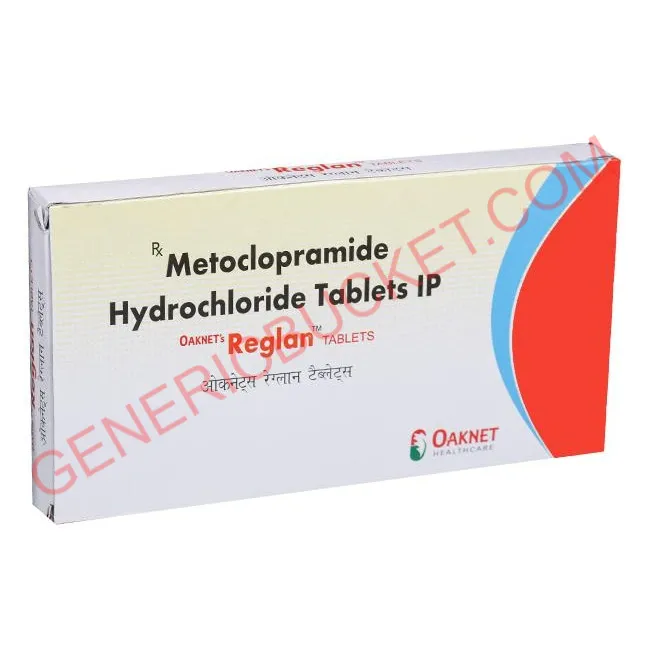

Reglan Tablet (Metoclopramide 10mg)
Price range: $45.00 through $110.00
| Country of Origin | India |
|---|---|
| Dosage Form | Tablets |
| Equivalent Brand | Reglan |
| Generic Name | Metoclopramide |
| Indication | Nausea, Vomiting, Heartburn |
| Manufacturer | Oaknet Healthcare Pvt Ltd |
| Packaging | 10 tablets in 1 strip |
| Composition | Metoclopramide (10mg) |
| Reglan Tablet (Metoclopramide 10mg) | |||
| Pack Size | Price | Price/Unit | Add To Cart |
| 100 Tablet/s | $45.00 (0.45/unit) | $0.45 | |
| 200 Tablet/s | $80.00 (0.4/unit) | $0.4 | |
| 300 Tablet/s | $110.00 (0.37/unit) | $0.37 | |
Reglan Tablet contains metoclopramide, a prescription medicine that helps manage certain digestive problems by improving movement through the upper gastrointestinal tract. It is primarily prescribed for adults with symptomatic, documented gastroesophageal reflux disease (GERD) who have not responded adequately to conventional treatment, and for adults experiencing symptoms associated with acute or recurrent diabetic gastroparesis.
What Is Reglan Tablet?
Reglan Tablet is an oral formulation of metoclopramide, a dopamine-2 receptor antagonist that affects gastrointestinal motility. The current U.S. prescribing information lists 5 mg and 10 mg tablet strengths. Healthcare professionals select the appropriate strength and schedule according to the patient’s condition, response, age, kidney function, and other medicines.
This medicine does not simply mask digestive discomfort. It helps coordinate movement in the upper digestive tract, which can help food move more efficiently through the stomach. Because digestive symptoms can have many causes, patients should use this medicine only after a healthcare professional has evaluated the underlying condition.
What Does Reglan Tablet Treat?
Doctors may prescribe Reglan Tablet for two main adult indications. First, it can treat symptomatic, documented GERD in adults who have failed conventional therapy. The FDA-approved labeling limits this treatment to 4 to 12 weeks. Second, it can relieve symptoms associated with acute and recurrent diabetic gastroparesis, a condition in which the stomach empties more slowly than normal.
Symptoms of diabetic gastroparesis can include nausea, vomiting, persistent fullness after eating, heartburn, and reduced appetite. Treatment may improve these symptoms when delayed gastric emptying contributes to them. Reglan Tablet should not be promoted as a universal cure for nausea, acid reflux, or stomach problems because its approved uses are specific and require medical assessment.
How Reglan Tablet Works
The active ingredient, metoclopramide, increases upper gastrointestinal motility without stimulating gastric, biliary, or pancreatic secretions. This action can help the stomach and upper digestive tract move contents forward more effectively.
Patients should understand that the response varies from person to person. Some symptoms may improve earlier than others, and the underlying disease may still require additional treatment. A healthcare professional should determine whether continued therapy remains appropriate.
Reglan Tablet Dosage and Administration
The prescribed dose depends on the condition being treated. For adults with symptomatic, documented GERD, the current labeling recommends 10 to 15 mg orally 30 minutes before each meal and at bedtime, with a maximum of 60 mg per day when continuous treatment is selected. Treatment generally lasts 4 to 12 weeks. For acute and recurrent diabetic gastroparesis, the recommended adult oral dose is 10 mg four times daily, taken 30 minutes before each meal and at bedtime.
These are prescribing-information recommendations, not instructions for self-treatment. Do not change your dose, frequency, or treatment duration without medical advice. Patients with reduced kidney function, certain liver problems, older adults, or those taking particular interacting medicines may require dosage adjustments.
Important Safety Information
The most important safety concern with Reglan Tablet is tardive dyskinesia (TD), a potentially irreversible movement disorder. The risk increases with treatment duration and cumulative exposure. The FDA recommends using metoclopramide for the shortest duration appropriate and periodically reassessing whether continued treatment remains necessary. Patients should stop treatment and promptly contact their healthcare professional if they develop abnormal involuntary movements or other symptoms suggestive of TD.
Treatment lasting longer than 12 weeks should generally be avoided except in rare circumstances where the expected benefit outweighs the risk. For diabetic gastroparesis, the labeling specifically advises avoiding a total treatment duration longer than 12 weeks.
Who Should Not Take It?
Reglan Tablet is contraindicated in people with a history of tardive dyskinesia or a dystonic reaction to metoclopramide. It should also not be used when stimulating gastrointestinal movement could be dangerous, such as with gastrointestinal bleeding, mechanical obstruction, or perforation. It is contraindicated in patients with pheochromocytoma or certain catecholamine-releasing paragangliomas because it can precipitate a dangerous hypertensive crisis.
The current U.S. label does not recommend Reglan Tablet for pediatric patients because of risks including tardive dyskinesia, other extrapyramidal symptoms, and methemoglobinemia in neonates.
Possible Side Effects
Common or clinically important adverse effects can include drowsiness, fatigue, restlessness, and movement-related reactions. More serious reactions require prompt medical attention. Patients should report involuntary movements, muscle spasms, severe restlessness, unusual facial or tongue movements, confusion, or other concerning neurological changes to their healthcare professional.
Because metoclopramide can affect the nervous system, patients should understand how the medicine affects them before driving, operating machinery, or performing activities requiring alertness. Alcohol and other medicines that cause sedation may increase impairment.
Drug Interactions and Precautions
Before starting Reglan Tablet, provide your healthcare professional with a complete list of prescription medicines, nonprescription products, and supplements. Metoclopramide can interact with medicines that affect the central nervous system and with certain drugs that inhibit CYP2D6. The current labeling identifies strong CYP2D6 inhibitors and provides specific recommendations for dosage adjustment or avoidance in certain situations.
Patients with moderate or severe renal impairment may need lower doses because metoclopramide is substantially eliminated through the kidneys. Older adults may also be more sensitive to its therapeutic and adverse effects.
Why Choose Reglan Tablet Responsibly?
When prescribed appropriately, Reglan Tablet can provide an established treatment option for specific gastrointestinal conditions. The best results come from using it exactly as prescribed, following the recommended treatment duration, and maintaining follow-up with a qualified healthcare professional.
If you are considering purchasing Reglan Tablet, use a legitimate, licensed pharmacy and provide a valid prescription where required. Check the medicine’s name, strength, packaging, expiration date, and dispensing instructions before use. Avoid purchasing prescription medicine from unverified sellers simply because they advertise unusually low prices.
Frequently Asked Questions
1. Is Reglan Tablet an antibiotic?
No. Reglan Tablet contains metoclopramide and works primarily by affecting gastrointestinal motility and dopamine receptors. It is not an antibiotic.
2. Is Reglan Tablet used for acid reflux?
Yes, but only for specific adults with symptomatic, documented GERD who have failed conventional therapy. The FDA-approved treatment duration is limited to 4 to 12 weeks.
3. Can Reglan Tablet cure gastroparesis?
It can relieve symptoms associated with acute and recurrent diabetic gastroparesis, but it should not be described as a permanent cure. Your clinician should manage the underlying condition and determine whether this medicine remains appropriate.
4. How long can I take Reglan Tablet?
Treatment should generally remain as short as clinically appropriate. The FDA warns against treatment beyond 12 weeks except in rare circumstances because the risk of tardive dyskinesia increases with duration and cumulative exposure.
5. What should I do if I notice unusual movements?
Contact your healthcare professional promptly. Abnormal involuntary movements can indicate tardive dyskinesia or another movement-related reaction and require medical evaluation.
Related products

Anti Emetic

Anti Emetic

Anti Emetic


Acid Reducers

Anti Emetic

Anti Emetic


Anti Emetic

Anti Emetic

Anti Emetic