
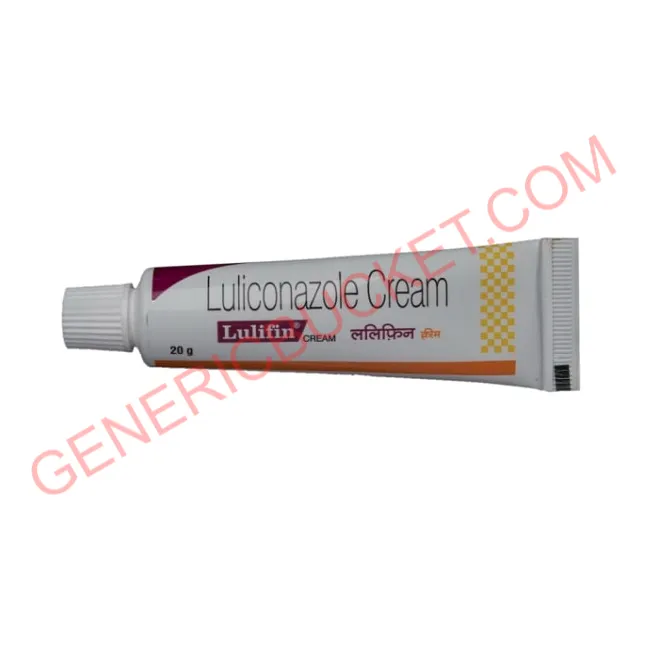

Lulifin Cream (Luliconazole 1%) 20gm
Price range: $45.00 through $124.00
| Active Ingredient (Generic Name): | Luliconazole |
|---|---|
| Indication: | used in the treatment of fungal infections |
| Manufacturer: | Sun Pharmaceutical Industries Ltd |
| Packaging: | 20 gm in 1 tube |
| Strength | Luliconazole (1% w/w) |
| Pack Size | 3 Tube/s, 6 Tube/s, 9 Tube/s |
| Lulifin Cream (Luliconazole 1%) 20gm | |||
| Pack Size | Price | Price/Unit | Add To Cart |
| 3 Tube/s | $45.00 (15/unit) | $15 | |
| 6 Tube/s | $86.00 (14.33/unit) | $14.33 | |
| 9 Tube/s | $124.00 (13.78/unit) | $13.78 | |
Lulifin Cream is a topical antifungal treatment containing luliconazole, an azole antifungal medicine used to treat certain fungal infections of the skin. It can help manage conditions such as athlete’s foot between the toes (interdigital tinea pedis), jock itch (tinea cruris), and ringworm (tinea corporis) when caused by susceptible dermatophytes.
Fungal skin infections can cause itching, redness, scaling, burning, cracking, and discomfort. They can also spread to surrounding skin when treatment is delayed. Lulifin Cream works directly at the affected skin to help control the fungus responsible for the infection. Because the appearance of fungal infections can resemble eczema, dermatitis, psoriasis, or other skin conditions, an accurate diagnosis is important before treatment.
How Lulifin Cream Works
The active ingredient in Lulifin Cream, luliconazole, belongs to the imidazole class of antifungal medicines. It interferes with fungal cell membrane formation, helping stop fungal growth and supporting clearance of the infection. Luliconazole 1% cream is specifically indicated in U.S. prescribing information for interdigital tinea pedis, tinea cruris, and tinea corporis caused by Trichophyton rubrum and Epidermophyton floccosum.
This targeted antifungal action makes Lulifin Cream useful when a healthcare professional has identified a susceptible dermatophyte infection. It is important to understand that an antifungal cream does not treat every type of rash. Using it for an unrelated skin condition may delay appropriate treatment.
Uses and Benefits
Lulifin Cream may help treat fungal infections that produce common symptoms such as itching, redness, scaling, and irritation. Its approved topical uses include athlete’s foot between the toes, jock itch, and ringworm. Clinical studies of luliconazole 1% demonstrated antifungal and clinical benefits compared with vehicle treatment in these conditions.
For people dealing with athlete’s foot, Lulifin Cream can be applied to the affected skin and the immediate surrounding area as directed. Keeping the feet clean and dry can also support treatment and reduce conditions that encourage fungal growth. For jock itch and ringworm, treatment should follow the prescribed schedule rather than stopping simply because itching begins to improve.
How to Apply Lulifin Cream
Use Lulifin Cream exactly as directed by your healthcare professional or according to the product’s prescribing information. For interdigital athlete’s foot, U.S. prescribing information directs application of a thin layer to the affected area and approximately one inch of surrounding skin once daily for two weeks. For tinea cruris and tinea corporis, the labeled regimen is once daily for one week.
Before applying Lulifin Cream, gently clean and thoroughly dry the affected area. Apply a thin layer rather than using an unnecessarily large amount. Wash your hands before and after application unless your hands are the treatment area. Continue the prescribed course even if symptoms improve earlier, unless your healthcare professional tells you otherwise.
Do not apply Lulifin Cream inside the eyes, mouth, vagina, or other mucous membranes. The medicine is intended for topical skin use only.
Related Product
Important Precautions
Although Lulifin Cream is generally used locally on the skin, some people can experience application-site reactions. Clinical trials reported application-site reactions in less than 1% of treated subjects. Postmarketing reports have also included contact dermatitis and cellulitis.
Stop using the product and contact a healthcare professional if you develop significant irritation, worsening inflammation, swelling, severe discomfort, or another concerning reaction. Avoid getting Lulifin Cream into the eyes or mouth. If accidental eye exposure occurs, rinse thoroughly with water and seek medical advice if irritation persists.
Tell your healthcare professional about other medicines you use and any relevant medical conditions. Although topical absorption is limited, prescribing information notes that luliconazole can affect CYP2C19 activity, particularly with substantial topical exposure.
Treatment Expectations
When using Lulifin Cream, symptom improvement may occur before the infection has completely cleared. Do not assume that disappearance of itching alone means the fungus has been eliminated. Follow the full treatment schedule prescribed for your particular infection.
Good hygiene also matters. Keep affected areas clean and dry, change socks regularly when treating athlete’s foot, avoid sharing towels or clothing, and wash clothing that comes into contact with the infected area. These measures can help reduce reinfection and transmission.
If your symptoms do not improve, become worse, or repeatedly return, speak with a healthcare professional. A persistent rash may require confirmation of the diagnosis or a different treatment approach.
Why Choose Lulifin Cream?
For an appropriately diagnosed dermatophyte infection, Lulifin Cream offers a convenient once-daily topical treatment regimen. Luliconazole 1% has established prescription use for specific fungal skin infections, and its clinical studies evaluated outcomes including clinical cure and mycological cure.
Choose your treatment based on the infection you actually have rather than treating every itchy or red rash as fungus. If a healthcare professional has recommended luliconazole, using Lulifin Cream according to the prescribed directions can help you manage the infection safely and effectively.
Frequently Asked Questions
What is Lulifin Cream used for?
Lulifin Cream contains luliconazole, an azole antifungal. Luliconazole 1% is indicated for certain cases of interdigital athlete’s foot, jock itch, and ringworm caused by susceptible dermatophytes.
How often should I use Lulifin Cream?
The U.S. labeled regimen for luliconazole 1% is once daily. Interdigital tinea pedis is treated for two weeks, while tinea cruris and tinea corporis are treated for one week. Follow your prescriber’s specific instructions.
Can Lulifin Cream treat every type of rash?
No. Lulifin Cream treats specific fungal infections and should not be assumed to treat eczema, psoriasis, bacterial infections, or other nonfungal rashes.
Can I use Lulifin Cream on my face?
Use it only on areas recommended by your healthcare professional. The U.S. labeling specifies topical use and warns against ophthalmic, oral, and intravaginal use.
What side effects can occur?
Possible reactions include irritation or other application-site reactions. Clinical trials reported application-site reactions in less than 1% of subjects. Contact dermatitis and cellulitis have also been reported after approval.
Be the first to review “Lulifin Cream (Luliconazole 1%) 20gm”
Related products

Anti fungal

Anti fungal

Anti fungal
Anti fungal
Anti fungal
Anti fungal
Anti fungal

Anti fungal
Anti fungal
Anti fungal
Anti fungal
Anti fungal
Reviews
There are no reviews yet.