

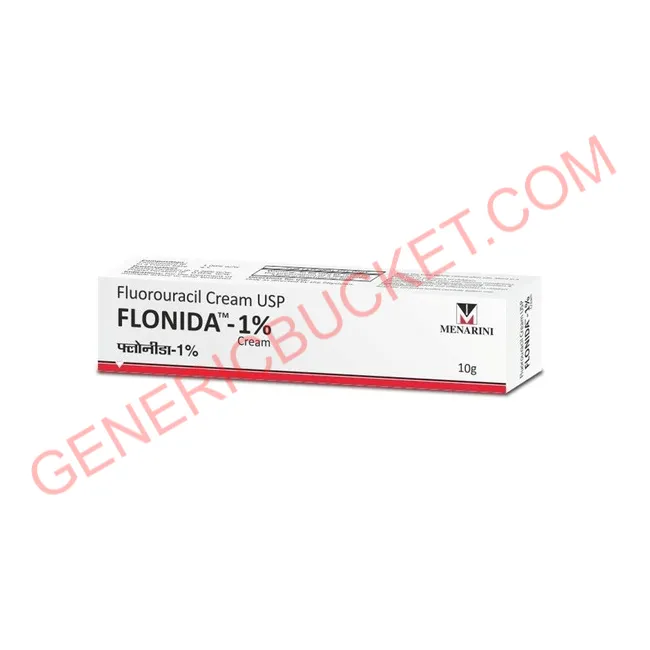

Flonida 1% Cream (Fluorouracil 1%)
Price range: $25.00 through $88.00
| Country of Origin | India |
|---|---|
| Dosage Form | Cream |
| Equivalent Brand | Fluoroplex |
| Generic Name | Fluorouracil |
| Indication | Skin cancer |
| Manufacturer | Menarini India Pvt Ltd |
| Packaging | 10 gm in 1 tube |
| Composition | Fluorouracil (1% w/w) |
| Pack Size | 3 Tube/s, 6 Tube/s, 12 Tube/s |
| Flonida 1% Cream (Fluorouracil 1%) | |||
| Pack Size | Price | Price/Unit | Add To Cart |
| 3 Tube/s | $25.00 (8.33/unit) | $8.33 | |
| 6 Tube/s | $46.00 (7.67/unit) | $7.67 | |
| 12 Tube/s | $88.00 (7.33/unit) | $7.33 | |
Flonida 1% Cream is a prescription topical medicine containing fluorouracil 1% w/w, used under medical supervision to treat certain abnormal or precancerous skin conditions, particularly actinic keratosis. If your dermatologist has prescribed this treatment, understanding how it works, how to apply it, and what reactions to expect can help you use it safely and confidently.
What Is Flonida 1% Cream?
Flonida 1% Cream contains fluorouracil, a topical antimetabolite medicine that interferes with the growth and multiplication of abnormal skin cells. It is designed for external use and should be applied only to the areas specified by your healthcare professional. The product is marketed as a 1% w/w fluorouracil formulation.
Doctors commonly prescribe topical fluorouracil for actinic keratoses, which appear as rough, scaly, crusty, or discolored patches on sun-exposed skin. These lesions develop after long-term ultraviolet exposure and can sometimes progress to squamous cell carcinoma. Your dermatologist should confirm the diagnosis before you begin treatment because not every rough or scaly skin lesion requires fluorouracil.
Depending on the clinical situation, doctors may also use fluorouracil preparations for selected superficial skin cancers or other conditions. The exact indication, treatment area, frequency, and duration should come from your prescriber rather than from a general product description.
How Flonida 1% Cream Works
Fluorouracil interferes with DNA and RNA production in rapidly dividing abnormal cells. This makes those cells less able to grow and survive. Because abnormal and precancerous skin cells can be particularly sensitive to fluorouracil, topical treatment can help remove targeted lesions while allowing healthier skin to recover afterward.
During treatment, the targeted area can become red, irritated, dry, swollen, tender, or crusted. Although these reactions may look concerning, local inflammation can occur as the medicine acts on abnormal cells. Your dermatologist can tell you whether the reaction you experience is expected or requires a change in treatment.
Uses and Potential Benefits
The main reported use of Flonida 1% Cream is treatment of actinic keratosis. These lesions often occur on areas that receive substantial sunlight, including the face, scalp, ears, forearms, hands, and other exposed areas.
By targeting abnormal cells, fluorouracil treatment can help clear clinically identified precancerous lesions and improve the appearance and texture of treated skin. In selected patients, topical fluorouracil may also form part of treatment for certain superficial skin cancers, including some superficial basal cell carcinomas or Bowen’s disease, when a clinician considers topical treatment appropriate.
Do not use Flonida 1% Cream simply to treat an unexplained skin spot. A dermatologist should evaluate suspicious lesions before treatment, particularly lesions that bleed, rapidly enlarge, change color, become painful, or fail to heal.
Related Product
How to Apply Flonida 1% Cream
Use Flonida 1% Cream exactly as your healthcare professional prescribes. Before application, gently clean and dry the treatment area. Apply only the prescribed amount as a thin layer to the affected skin. Wash your hands before and after application unless your hands themselves are the treatment area.
Avoid contact with the eyes, mouth, nose, and other sensitive areas. Do not apply the medicine to open or damaged skin unless your doctor specifically instructs you to do so. Do not cover treated skin with an occlusive dressing unless your prescriber tells you to use one.
Never apply extra cream to make treatment work faster. Using more than prescribed can increase irritation and other adverse effects without providing additional benefit.
What to Expect During Treatment
Topical fluorouracil can produce a noticeable local reaction. You may experience redness, burning, itching, dryness, peeling, tenderness, swelling, or crusting at the treatment site.
The intensity of the reaction varies from person to person and depends on factors such as the treatment area and duration. Follow your dermatologist’s instructions rather than stopping treatment automatically when the skin becomes irritated. At the same time, contact your healthcare professional if the reaction becomes severe, unusually painful, develops significant ulceration, or concerns you.
Your skin may also become more sensitive to sunlight during treatment. Protect the treated area from excessive sun exposure with appropriate clothing and sun protection as recommended by your healthcare professional.
Important Safety Information
Because Flonida 1% Cream contains fluorouracil, it should be treated as a prescription medicine rather than an ordinary cosmetic cream. Tell your healthcare professional about allergies, current medicines, other topical treatments, and any relevant medical conditions before starting therapy.
Pregnancy and breastfeeding require particular caution. Current product information advises patients who are pregnant, planning pregnancy, or breastfeeding to discuss fluorouracil treatment with their healthcare professional before use.
Keep this medicine away from children and use it only for the person and condition for which it was prescribed. Store it according to the product label; available product information lists storage below 30°C.
Why Choose Flonida 1% Cream?
When your dermatologist recommends topical fluorouracil, Flonida 1% Cream provides a convenient topical formulation for targeted treatment. Its active ingredient, fluorouracil 1% w/w, works directly at the treated skin site and can be incorporated into a dermatologist-directed treatment plan for actinic keratosis and selected other skin conditions.
For prescription medicines, responsible purchasing matters. Before ordering, confirm the strength, formulation, prescription requirements, packaging, expiry date, and instructions provided by your healthcare professional. Choose a legitimate pharmacy and do not substitute another fluorouracil product without professional guidance.
Frequently Asked Questions
1. What is Flonida 1% Cream used for?
It is primarily used for actinic keratosis and may be prescribed for selected superficial skin conditions or cancers when medically appropriate.
2. Is Flonida 1% Cream a steroid?
No. It contains fluorouracil 1% w/w, not a corticosteroid. Fluorouracil is an antimetabolite medicine used topically to target abnormal cells.
3. Can I use Flonida 1% Cream for acne?
It is not a routine acne treatment. Do not apply fluorouracil to acne unless a qualified healthcare professional specifically prescribes it for a particular dermatologic reason.
4. Can I stop treatment when my skin becomes red?
Do not change or stop your prescribed treatment without consulting your dermatologist. Redness and irritation can occur during topical fluorouracil treatment, but severe reactions require medical assessment.
5. Can I use makeup over Flonida 1% Cream?
Ask your healthcare professional before applying cosmetics or other skincare products over the treatment area. Avoid products that further irritate treated skin.
Be the first to review “Flonida 1% Cream (Fluorouracil 1%)”
Related products

Anti Cancer

Anti Cancer

Anti Cancer

Anti Cancer

Anti Cancer

Anti Cancer


Anti Cancer

Anti Cancer

Anti Cancer

Anti Cancer

Anti Cancer
Reviews
There are no reviews yet.