
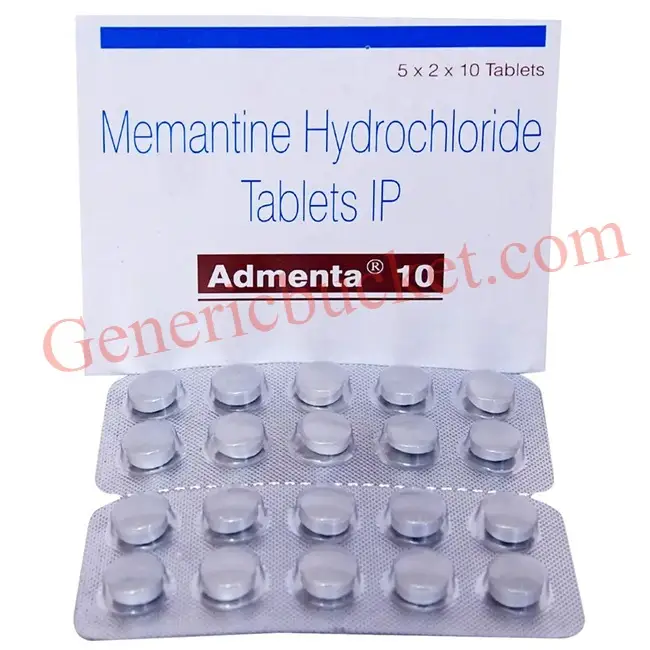

Admenta 10mg Tablet (Memantine 10mg)
Price range: $64.00 through $176.00
| Country of Origin | India |
|---|---|
| Dosage Form | Tablets |
| Equivalent Brand | Namenda |
| Generic Name | Memantine |
| Indication | Alzheimer's disease |
| Manufacturer | Sun Pharmaceutical Industries Ltd |
| Packaging | 10 tablets in 1 strip |
| Composition | Memantine (10mg) |
| Admenta 10mg Tablet (Memantine 10mg) | |||
| Pack Size | Price | Price/Unit | Add To Cart |
| 50 Tablet/s | $64.00 (1.28/unit) | $1.28 | |
| 100 Tablet/s | $120.00 (1.2/unit) | $1.2 | |
| 150 Tablet/s | $176.00 (1.17/unit) | $1.17 | |
Admenta 10mg Tablet contains memantine hydrochloride 10 mg and is used under medical supervision to help manage symptoms associated with moderate to severe Alzheimer’s disease. The product is listed by Sun Pharma as containing memantine 10 mg.
Alzheimer’s disease can gradually affect memory, thinking, communication, judgment, and the ability to perform everyday activities. Admenta 10mg Tablet does not cure Alzheimer’s disease or reverse the underlying brain changes. Instead, memantine may help regulate abnormal glutamate activity in the brain and can help some patients maintain cognitive and functional abilities for longer.
What Is Admenta 10mg Tablet?
Admenta 10mg Tablet is an oral prescription medicine containing memantine hydrochloride. Memantine belongs to a class of medicines called NMDA receptor antagonists. It works differently from cholinesterase inhibitors and may be prescribed alone or alongside another Alzheimer’s medicine when clinically appropriate.
The medicine acts on NMDA receptors involved in glutamate signaling. Excessive or prolonged stimulation of these receptors may contribute to neuronal dysfunction. Memantine helps moderate this activity, which may support cognitive and functional symptoms in people with moderate to severe Alzheimer’s disease.
Uses and Potential Benefits
Doctors prescribe Admenta 10mg Tablet primarily for moderate to severe Alzheimer’s dementia. Clinical treatment aims to manage symptoms rather than eliminate the disease. Patients and caregivers may notice benefits differently, and some people may experience a stabilization or slower decline rather than an obvious improvement.
Potential treatment goals can include supporting memory, thinking, attention, communication, and the ability to perform certain everyday activities. The medicine should form only one part of a comprehensive Alzheimer’s care plan that may include medical follow-up, appropriate activity, nutrition, caregiver support, and management of other medical conditions.
It is important to understand that Admenta 10mg Tablet cannot guarantee improvement in every patient. Alzheimer’s disease progresses differently from person to person, so the prescribing clinician should regularly evaluate whether continued treatment remains appropriate.
How to Take Admenta 10mg Tablet
Take Admenta 10mg Tablet exactly as prescribed by your healthcare professional. Available product information indicates that the tablet can generally be taken with or without food. Taking it at approximately the same time each day can help maintain a consistent routine.
Do not change the dose, take extra tablets, or stop treatment on your own. Memantine treatment is commonly introduced gradually, with the prescriber adjusting the dose according to response, tolerability, kidney function, and the particular product regimen.
If you miss a dose, follow your prescriber’s or pharmacist’s instructions. Do not double the next dose unless a healthcare professional specifically tells you to do so.
Who Should Use This Medicine Carefully?
Before starting Admenta 10mg Tablet, tell your healthcare professional about all medical conditions and medicines you use. Kidney impairment is particularly important because memantine is eliminated substantially through the kidneys, and dose adjustments may be necessary in patients with significant renal impairment.
Tell your clinician about prescription medicines, over-the-counter products, vitamins, and supplements. Your pharmacist can review your medication list for potential interactions and help you use Admenta 10mg Tablet safely.
People with a history of seizures or certain urinary or kidney conditions should also discuss their history with their prescriber before treatment. Never assume that a prescription medicine is appropriate simply because another person uses it.
Related Product
Possible Side Effects
Like other prescription medicines, Admenta 10mg Tablet can cause side effects. Report troublesome or persistent symptoms to your healthcare professional.
Possible adverse effects associated with memantine include dizziness, headache, constipation, confusion, and sleepiness. Some patients may experience changes in balance or blood pressure.
Dizziness or sleepiness can increase the risk of falls, particularly in older adults. Until you know how the medicine affects you, use caution with driving, operating machinery, or activities requiring alertness.
Seek prompt medical attention for serious, unusual, or rapidly worsening symptoms. A pharmacist or physician can help determine whether a symptom represents a medication reaction or another medical problem.
Important Safety Advice
Keep Admenta 10mg Tablet out of the reach of children and store it according to the product labeling. Do not share prescription medicine with another person, even when that person appears to have similar symptoms.
Caregivers should maintain an accurate medication schedule because people with dementia may forget whether they have taken a dose. Keeping regular appointments also allows the healthcare team to assess memory, daily functioning, adverse effects, kidney function, and overall treatment goals.
Most importantly, do not describe Admenta 10mg Tablet as a cure for Alzheimer’s disease. Current treatment focuses on symptom management and maintaining function rather than eliminating the disease.
Why Professional Guidance Matters
Choosing Admenta 10mg Tablet should involve a qualified healthcare professional who understands the patient’s medical history and current medicines. A pharmacist can explain administration, identify potential medication problems, discuss common adverse effects, and reinforce the prescribed schedule.
Because Alzheimer’s disease affects both patients and caregivers, clear medication counseling can make treatment easier to manage. Keep a current medication list and bring it to healthcare appointments.
If your clinician has prescribed Admenta 10mg Tablet, use the medicine according to the prescription rather than relying on online dosing advice. When purchasing prescription medicines online, use a legitimate pharmacy and verify that the product comes from an authorized supply chain.
Frequently Asked Questions
Is Admenta 10mg Tablet a cure for Alzheimer’s disease?
No. Admenta 10mg Tablet does not cure Alzheimer’s disease. It contains memantine, which is used to manage symptoms associated with moderate to severe Alzheimer’s dementia and may help slow functional or cognitive decline in some patients.
What is the active ingredient in Admenta 10mg Tablet?
The active ingredient is memantine hydrochloride 10 mg. Product information identifies Admenta 10mg Tablet as a memantine 10 mg formulation.
Can I take Admenta 10mg Tablet with food?
Product information indicates that memantine tablets may generally be taken with or without food. Follow the specific instructions provided by your prescriber and the product labeling.
Can I stop Admenta 10mg Tablet suddenly?
Do not stop Admenta 10mg Tablet without discussing it with your healthcare professional. Your clinician can determine whether treatment should continue, change, or stop.
Does Admenta 10mg Tablet improve memory immediately?
Not necessarily. Treatment response varies considerably. The goal may be stabilization or slower decline rather than an immediate improvement in memory. Your healthcare professional should assess the treatment over time.
Related products


Alzheimers
Alzheimers

Alzheimers
Alzheimers

Alzheimers

Alzheimers

Alzheimers
Alzheimers

Alzheimers
Alzheimers