
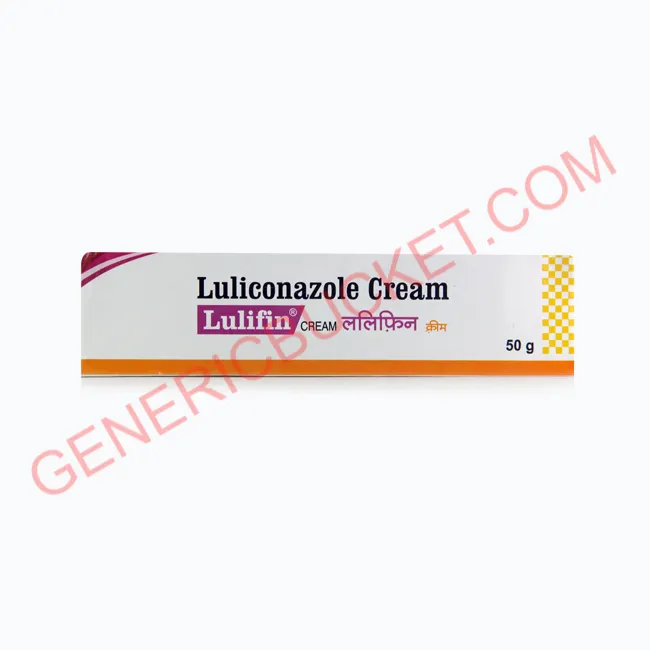

Lulifin Cream (Luliconazole 1%) 50gm
Price range: $20.00 through $105.00
| Active Ingredient (Generic Name): | Luliconazole |
|---|---|
| Indication: | used in the treatment of fungal infections |
| Manufacturer: | Sun Pharmaceutical Industries Ltd |
| Packaging: | 50 gm in 1 tube |
| Strength | Luliconazole (1% w/w) |
| Pack Size | 1 Tube/s, 3 Tube/s, 6 Tube/s |
| Lulifin Cream (Luliconazole 1%) 50gm | |||
| Pack Size | Price | Price/Unit | Add To Cart |
| 1 Tube/s | $20.00 (20/unit) | $20 | |
| 3 Tube/s | $55.00 (18.33/unit) | $18.33 | |
| 6 Tube/s | $105.00 (17.5/unit) | $17.5 | |
Lulifin Cream is a topical antifungal medicine containing luliconazole, an azole antifungal that helps treat certain fungal infections of the skin. It is commonly used for conditions such as athlete’s foot between the toes, jock itch, and ringworm when prescribed for the appropriate infection. Luliconazole works by interfering with fungal growth, helping the affected skin recover as the infection clears.
What Is Lulifin Cream?
Lulifin Cream is formulated with luliconazole, an antifungal active ingredient. U.S. labeling for luliconazole 1% cream identifies it as a prescription topical treatment for interdigital tinea pedis, tinea cruris, and tinea corporis caused by susceptible dermatophytes, including Trichophyton rubrum and Epidermophyton floccosum. Each gram of 1% cream contains 10 mg of luliconazole.
Fungal skin infections can cause itching, redness, scaling, burning, cracking, and discomfort. Because these symptoms can resemble other skin conditions, patients should use an antifungal treatment when a healthcare professional has diagnosed or reasonably identified a fungal infection. Lulifin Cream should not be promoted as a treatment for every type of rash or skin irritation.
How Does Lulifin Cream Work?
Luliconazole belongs to the azole class of antifungal medicines. It interferes with an enzyme involved in the production of ergosterol, an important component of fungal cell membranes. Disrupting this process weakens fungal growth and helps the body clear the infection.
This targeted antifungal action makes Lulifin Cream useful for susceptible dermatophyte infections affecting areas such as the feet, groin, and body. Treatment works best when patients apply the medicine exactly as prescribed and maintain good skin hygiene during therapy.
Uses and Benefits
Healthcare professionals may prescribe Lulifin Cream for several common dermatophyte infections. For interdigital athlete’s foot, the infection typically affects the skin between the toes and may cause itching, scaling, redness, or cracking. For tinea cruris, commonly called jock itch, the infection generally affects the groin and nearby skin. Tinea corporis, commonly called ringworm, can produce circular or expanding patches on areas such as the trunk, arms, or legs.
A major benefit of luliconazole treatment is its convenient once-daily application under the labeled regimens. This can make it easier for patients to maintain consistent treatment. However, patients should follow the specific directions provided by their prescriber because treatment duration depends on the infection being treated.
How to Apply Lulifin Cream
Use Lulifin Cream only on the skin and follow your healthcare professional’s instructions. Before applying the cream, gently clean and completely dry the affected area. Apply a thin layer to the affected skin and, according to the U.S. labeling for luliconazole 1% cream, approximately 1 inch of the surrounding skin.
For interdigital tinea pedis, the labeled regimen is once daily for 2 weeks. For tinea cruris and tinea corporis, the labeled regimen is once daily for 1 week.
Do not use more cream than directed, and do not stop treatment early simply because symptoms begin to improve. Completing the prescribed course helps provide the best opportunity for successful treatment.
Related Product
Important Precautions
Lulifin Cream is intended for topical use only. Do not apply it inside the eyes, mouth, or vagina, and do not use it orally.
Avoid unnecessary application to broken or severely irritated skin unless your healthcare professional specifically instructs you to do so. Wash your hands before and after application unless your hands are the treatment area.
Tell your healthcare professional about other medicines, skincare products, allergies, pregnancy, or breastfeeding before starting treatment. The FDA-approved patient information notes that pregnancy and breastfeeding should be discussed with a healthcare professional because the effects on an unborn or nursing baby are not fully established.
Possible Side Effects
Most people tolerate topical luliconazole well. Clinical trials reported application-site reactions in less than 1% of subjects.
Some people may experience local irritation or other skin reactions where the medicine is applied. If severe irritation, significant swelling, worsening redness, or another concerning reaction develops, stop using the product and contact your healthcare professional for advice.
If the infection does not improve after the prescribed treatment period, or if it repeatedly returns, seek medical evaluation. The underlying diagnosis may need confirmation or another treatment approach.
Why Choose Lulifin Cream?
When a healthcare professional determines that a dermatophyte infection is appropriate for topical luliconazole therapy, Lulifin Cream can provide a practical treatment option. Its once-daily regimen under labeled treatment schedules can support adherence, while its azole antifungal action directly targets fungal growth.
For customers considering this product, the safest approach is to purchase and use Lulifin Cream according to a valid prescription and professional medical advice. A pharmacy should provide the correct product, strength, directions, and counseling rather than encouraging self-treatment of an undiagnosed rash.
Frequently Asked Questions
1. What is Lulifin Cream used for?
Lulifin Cream contains luliconazole, a topical azole antifungal. Luliconazole 1% cream is indicated for interdigital athlete’s foot, jock itch, and ringworm caused by specified susceptible dermatophytes.
2. How often should I use Lulifin Cream?
The U.S. labeled regimen for luliconazole 1% cream is once daily. Interdigital athlete’s foot is treated for 2 weeks, while tinea cruris and tinea corporis are treated for 1 week. Follow your own prescription directions.
3. Can I use Lulifin Cream for any rash?
No. Not every rash results from a fungal infection. Using an antifungal medicine for an unrelated skin condition may delay appropriate treatment. Ask a healthcare professional if you are unsure about the diagnosis.
4. Can I apply it to my face?
Do not use Lulifin Cream on the face unless your healthcare professional specifically directs you to do so. The approved indications for luliconazole 1% cream concern specific dermatophyte infections rather than general facial rashes.
5. Can I use it inside my eyes or mouth?
No. Luliconazole cream is for topical skin use and should not be used ophthalmically or orally.
Be the first to review “Lulifin Cream (Luliconazole 1%) 50gm”
Related products

Anti fungal
Anti fungal

Anti fungal
Anti fungal
Anti fungal

Anti fungal

Anti fungal

Anti fungal
Anti fungal
Anti fungal
Anti fungal

Anti fungal
Reviews
There are no reviews yet.