
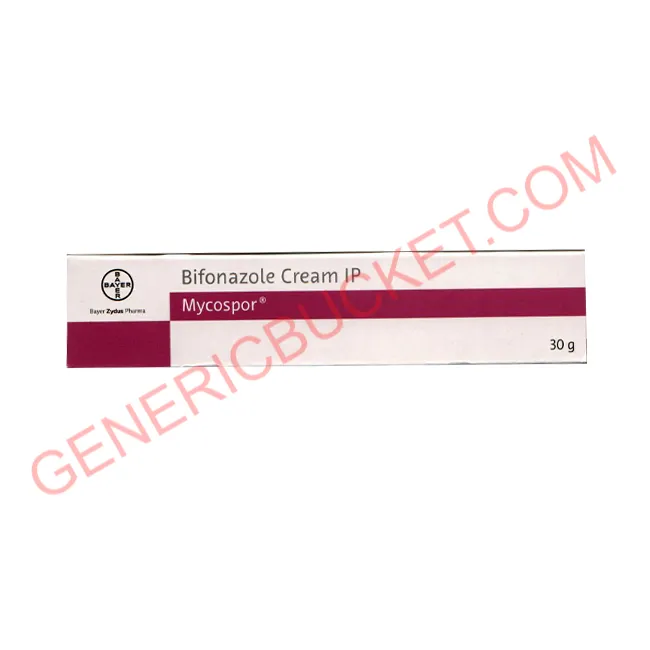

Mycospor Cream (Bifonazole 1%) 30gm
Price range: $38.00 through $104.00
| Country of Origin | India |
|---|---|
| Dosage Form | Cream |
| Equivalent Brand | Canesten Bifonazole Cream |
| Generic Name | Bifonazole |
| Indication | Fungal infections |
| Manufacturer | Bayer Pharmaceuticals Pvt Ltd |
| Packaging | 30 gm in 1 tube |
| Composition | Bifonazole (1% w/w) |
| Pack Size | 3 Tube/s, 6 Tube/s, 12 Tube/s |
| Mycospor Cream (Bifonazole 1%) 30gm | |||
| Pack Size | Price | Price/Unit | Add To Cart |
| 3 Tube/s | $38.00 (12.67/unit) | $12.67 | |
| 6 Tube/s | $72.00 (12/unit) | $12 | |
| 12 Tube/s | $104.00 (8.67/unit) | $8.67 | |
Mycospor Cream is a topical antifungal medicine containing bifonazole, an imidazole antifungal used to treat certain superficial fungal and yeast infections of the skin. It is designed for external application and can help address infections that cause itching, redness, scaling, burning, or irritated skin. Product information identifies bifonazole 1% (10 mg/g) as the active ingredient and lists conditions such as athlete’s foot, ringworm, jock itch, and other superficial fungal infections among its uses.
What Is Mycospor Cream?
Mycospor Cream contains bifonazole, which works against several types of fungi and yeasts responsible for superficial skin infections. Bifonazole interferes with ergosterol production at more than one stage. Ergosterol is important for maintaining the fungal cell membrane. By disrupting this process, bifonazole weakens the fungal membrane and helps stop the infection.
Because fungal infections can resemble eczema, dermatitis, bacterial infections, or other skin conditions, correct identification matters. If you are unsure whether your symptoms are caused by a fungus, speak with a pharmacist or healthcare professional before starting treatment. Using an antifungal when the underlying condition is not fungal may delay appropriate care.
Uses and Benefits
Mycospor Cream is used for several superficial fungal infections. Depending on the product’s approved labeling in your country, these may include tinea pedis (athlete’s foot), tinea corporis (ringworm of the body), tinea cruris (jock itch), tinea manuum (fungal infection of the hands), certain yeast infections of the skin, and pityriasis versicolor.
For athlete’s foot, the infection commonly affects the spaces between the toes and may produce itching, scaling, cracking, or burning. Ringworm can produce an expanding, scaly rash, while jock itch usually affects the groin and nearby skin. Treatment works best when you combine appropriate antifungal therapy with good hygiene and moisture control.
How Mycospor Cream Works
Mycospor Cream delivers bifonazole directly to the affected skin. The medicine penetrates infected skin layers and acts against fungal organisms at the site of infection. Bifonazole inhibits fungal ergosterol biosynthesis, causing structural and functional damage to the fungal cell membrane.
This mechanism helps control fungal growth and allows the affected skin to recover. However, improvement in itching or redness does not necessarily mean that the infection has completely cleared. Continue treatment for the duration recommended by the product labeling or your healthcare professional.
How to Apply Mycospor Cream
Before applying Mycospor Cream, gently clean the affected area and dry it thoroughly. Apply a thin layer to the affected skin and gently rub it in. Product information for Mycospor 1% cream describes once-daily application, preferably at night, although you should follow the instructions supplied with your particular product and the advice of your healthcare professional.
Wash your hands before and after application unless your hands themselves are being treated. Avoid getting the cream into your eyes, mouth, or other mucous membranes. Do not apply excessive amounts because using more medicine does not necessarily make the infection disappear faster and may increase irritation.
Important Hygiene Measures
Good hygiene can support treatment and reduce the chance of reinfection. Keep infected areas clean and dry, especially skin folds and the spaces between the toes. If you have athlete’s foot, change socks regularly and allow footwear to dry thoroughly. Avoid sharing towels, socks, shoes, clothing, or other personal items that may contact infected skin.
Do not cover treated skin with an airtight dressing unless a healthcare professional specifically recommends it. Occlusion can increase irritation and may alter medication absorption.
Possible Side Effects
Mycospor Cream can cause local skin reactions in some users. Possible effects include redness, itching, burning, irritation, peeling, or increased inflammation at the application site. These reactions are generally localized, but persistent or troublesome symptoms warrant professional advice.
Stop using the product and seek medical attention if you develop signs of a serious allergic reaction, such as swelling of the face, lips, tongue, or throat, difficulty breathing, or widespread severe rash.
Precautions Before Use
Do not use Mycospor Cream if you have previously experienced an allergic reaction to bifonazole, other imidazole antifungals, or any ingredient in the formulation. Avoid applying it to the eyes. Ask a healthcare professional before treating infants, during pregnancy or breastfeeding, or when the skin is severely damaged.
If symptoms become worse, spread extensively, or fail to improve with appropriate treatment, obtain a medical evaluation. Some persistent fungal infections require a different treatment approach or prescription therapy.
Storage and Handling
Store Mycospor Cream according to the instructions on the package. Some product information specifies storage below 30°C. Keep the tube tightly closed and away from excessive heat and direct sunlight. Keep all medicines out of the reach of children and do not use the product after its expiration date.
Why Choose Mycospor Cream?
Mycospor Cream provides targeted topical antifungal treatment in a convenient cream formulation. Its bifonazole ingredient has activity against dermatophytes, yeasts, molds, and other fungi associated with superficial infections.
When used correctly for an appropriate fungal infection, it can help control fungal growth and support gradual relief of associated skin symptoms. For safe purchasing, always verify the product strength, ingredients, packaging, expiration date, and applicable regulatory status before ordering. Availability and labeling can differ between countries, so U.S. customers should confirm that the product is legally marketed and appropriate for their intended use.
Common FAQs
1. What is Mycospor Cream used for?
Mycospor Cream is a topical antifungal used for certain superficial fungal and yeast infections of the skin, including conditions such as athlete’s foot, ringworm, and jock itch, depending on the applicable product labeling.
2. What is the active ingredient?
Mycospor Cream contains bifonazole. A commonly documented formulation contains 10 mg of bifonazole per gram, equivalent to 1% w/w.
3. How often should I apply it?
Mycospor Cream is commonly described as being applied once daily, preferably at bedtime, but always follow the directions supplied with your specific product or those provided by your healthcare professional.
4. Can I use it on broken skin?
Use caution on damaged or severely inflamed skin. Product information advises discussing such use with a healthcare professional because irritation and absorption may increase.
5. Can I stop when the itching disappears?
Do not stop treatment solely because symptoms improve. Fungal organisms can remain after visible symptoms decrease. Follow the recommended treatment duration on your product label or your clinician’s instructions.
Be the first to review “Mycospor Cream (Bifonazole 1%) 30gm”
Related products
Anti fungal

Anti fungal

Anti fungal
Anti fungal

Anti fungal

Anti fungal

Anti fungal

Anti fungal
Anti fungal
Anti fungal

Anti fungal

Anti fungal
Reviews
There are no reviews yet.