

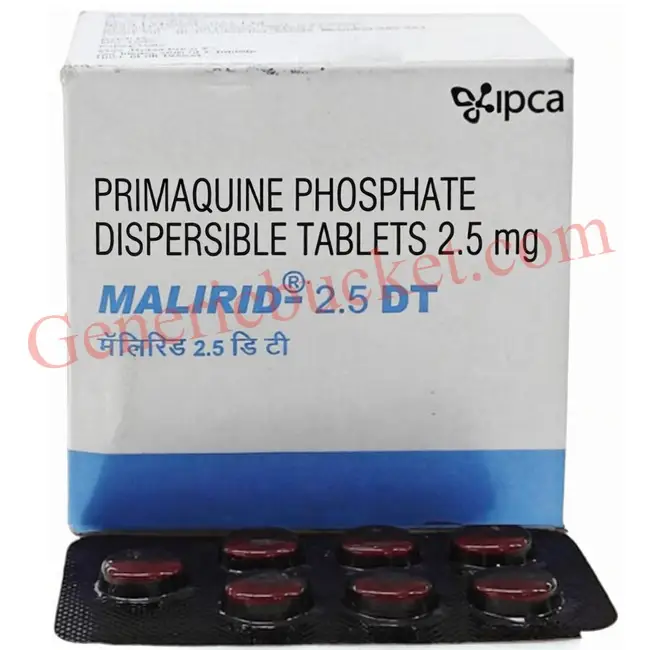

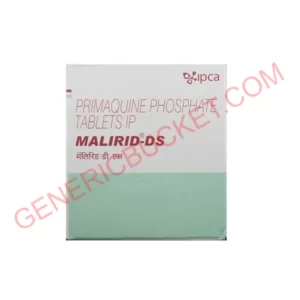
Malirid 2.5mg Tablet (Primaquine 2.5mg)
Price range: $22.00 through $38.00
| Country of Origin | India |
|---|---|
| Dosage Form | Tablets |
| Equivalent Brand | Primaquine |
| Generic Name | Primaquine |
| Indication | Malaria |
| Manufacturer | Ipca Laboratories Ltd |
| Packaging | 7 tablets in 1 strip |
| Composition | Primaquine (2.5mg) |
| Pack Size | 56 Tablet/s, 84 Tablet/s, 112 Tablet/s |
| Malirid 2.5mg Tablet (Primaquine 2.5mg) | |||
| Pack Size | Price | Price/Unit | Add To Cart |
| 56 Tablet/s | $22.00 (0.39/unit) | $0.39 | |
| 84 Tablet/s | $30.00 (0.36/unit) | $0.36 | |
| 112 Tablet/s | $38.00 (0.34/unit) | $0.34 | |
Malirid 2.5mg Tablet contains primaquine 2.5 mg and is an antimalarial medicine used under medical supervision for specific malaria infections, particularly to help eliminate malaria parasites that can remain dormant in the liver and cause relapse. Product information identifies Malirid 2.5mg Tablet DT as containing primaquine 2.5 mg and being manufactured by Ipca Laboratories.
Malaria requires prompt diagnosis and appropriate treatment because some malaria species can progress rapidly or return after the initial infection. Current CDC guidance explains that Plasmodium vivax and Plasmodium ovale can leave dormant liver-stage parasites, called hypnozoites, that may later reactivate. Primaquine is one of the medicines used for anti-relapse treatment when clinically appropriate.
What Is Malirid 2.5mg Tablet?
Malirid 2.5mg Tablet is a primaquine-containing antimalarial product. Primaquine belongs to the 8-aminoquinoline class and acts against liver-stage malaria parasites. This makes it different from medicines that primarily target parasites circulating in the blood. For P. vivax and P. ovale, healthcare professionals may prescribe an anti-relapse medicine after or alongside treatment for the acute blood-stage infection.
The 2.5 mg strength is particularly relevant when a clinician needs a smaller tablet strength, such as in pediatric treatment. However, the appropriate dose depends on the patient’s age, body weight, malaria species, treatment regimen, and medical condition. Patients should never calculate a primaquine dose independently.
Uses and Potential Benefits
Doctors may prescribe Malirid 2.5mg Tablet as part of a malaria treatment plan when primaquine is appropriate. Its principal role is to help eliminate susceptible malaria parasites residing in the liver, reducing the risk of relapse from infections such as P. vivax and P. ovale. CDC guidance recommends anti-relapse treatment for these infections after appropriate evaluation.
By targeting liver-stage parasites, primaquine complements treatment directed at parasites in the bloodstream. This distinction matters because eliminating blood-stage parasites alone may not prevent future relapse in infections capable of forming dormant liver stages.
How Malirid 2.5mg Tablet Works
Primaquine interferes with malaria parasites during stages of their development that occur outside the bloodstream, particularly in the liver. By eliminating susceptible dormant parasites, it helps prevent them from becoming active again and producing another episode of malaria. Official U.S. labeling describes primaquine as eliminating tissue-stage infection and identifies its role in preventing relapse of vivax malaria.
Because malaria treatment depends on the infecting species and the medicines already used, primaquine should form part of a clinician-directed treatment plan rather than serve as a stand-alone self-treatment for an undiagnosed fever.
Related Product
How to Take Malirid 2.5mg Tablet
Take Malirid 2.5mg Tablet exactly as prescribed by your healthcare professional. Do not increase, reduce, or stop the dose because symptoms improve. The total amount and duration of primaquine therapy determine treatment effectiveness, so completing the prescribed course is important.
Taking primaquine with food may reduce gastrointestinal discomfort. If you miss a dose, follow the instructions provided by your prescriber or pharmacist rather than doubling the next dose.
For children, caregivers should follow the exact pediatric instructions provided by the treating clinician. The tablet strength alone does not determine the correct dose.
G6PD Testing Is Essential
One of the most important safety considerations with Malirid 2.5mg Tablet is glucose-6-phosphate dehydrogenase (G6PD) status. Primaquine can cause potentially serious hemolytic anemia in people with G6PD deficiency. The CDC recommends quantitative G6PD testing before starting primaquine or tafenoquine.
Do not start primaquine without appropriate medical evaluation and G6PD testing. Seek urgent medical attention if you develop symptoms that may indicate hemolysis, such as unusual weakness, marked fatigue, shortness of breath, or dark-colored urine.
Side Effects
Some people may experience stomach upset, abdominal discomfort, nausea, or other gastrointestinal symptoms. Taking the medicine with food can help reduce stomach-related effects.
More serious blood-related reactions can occur, particularly in people with G6PD deficiency. Primaquine labeling also warns about hemolytic anemia and methemoglobinemia. Bluish lips or nails, severe weakness, breathing difficulty, or unusually dark urine require prompt medical assessment.
Who Should Avoid or Discuss It With a Doctor?
Do not use Malirid 2.5mg Tablet without medical advice if you have G6PD deficiency, a history of hemolytic anemia, or an allergy to primaquine or related medicines. Primaquine is also contraindicated during pregnancy. Breastfeeding requires specific assessment of the infant’s G6PD status.
Tell your healthcare professional about every prescription medicine, over-the-counter medicine, and supplement you use. Certain medicines can increase the risk of blood-related adverse effects or affect primaquine’s clinical response.
Storage and Handling
Keep Malirid 2.5mg Tablet in its original packaging and store it according to the product label. Available product information recommends storage below 30°C. Keep medicines away from excessive heat, moisture, and direct sunlight and out of children’s reach.
Why Choose the Correct Malaria Treatment?
Not every fever is malaria, and not every malaria infection requires the same treatment. Current CDC guidance emphasizes prompt laboratory diagnosis and species-specific therapy. For uncomplicated malaria, the treatment plan depends on the infecting species, geographic origin, disease severity, prior antimalarial exposure, and patient-specific factors.
For this reason, customers should purchase Malirid 2.5mg Tablet only when it has been recommended for their specific condition. A legitimate prescription and professional guidance help ensure the correct strength and regimen.
Frequently Asked Questions
What is Malirid 2.5mg Tablet used for?
It contains primaquine 2.5 mg and is used under medical supervision for specific malaria treatment plans, particularly to prevent relapse from susceptible liver-stage malaria parasites.
Is Malirid 2.5mg Tablet an antibiotic?
No. Primaquine is an antimalarial medicine, not an antibacterial antibiotic.
Can I take Malirid 2.5mg Tablet without a G6PD test?
You should not start primaquine without appropriate G6PD evaluation. Quantitative G6PD testing is recommended before primaquine treatment because deficiency can cause potentially serious hemolytic anemia.
Can pregnant women take primaquine?
No. Primaquine is contraindicated during pregnancy because of the potential risk of hemolytic anemia in a G6PD-deficient fetus.
Should I take Malirid 2.5mg Tablet with food?
Taking primaquine with food may reduce gastrointestinal side effects. Follow your prescriber’s specific instructions.
Be the first to review “Malirid 2.5mg Tablet (Primaquine 2.5mg)”
Related products
Anti Malarial
Anti Malarial
Anti Malarial
Anti Malarial

Anti Malarial

Anti Malarial
Anti Malarial

Anti Malarial
Anti Malarial
Reviews
There are no reviews yet.