
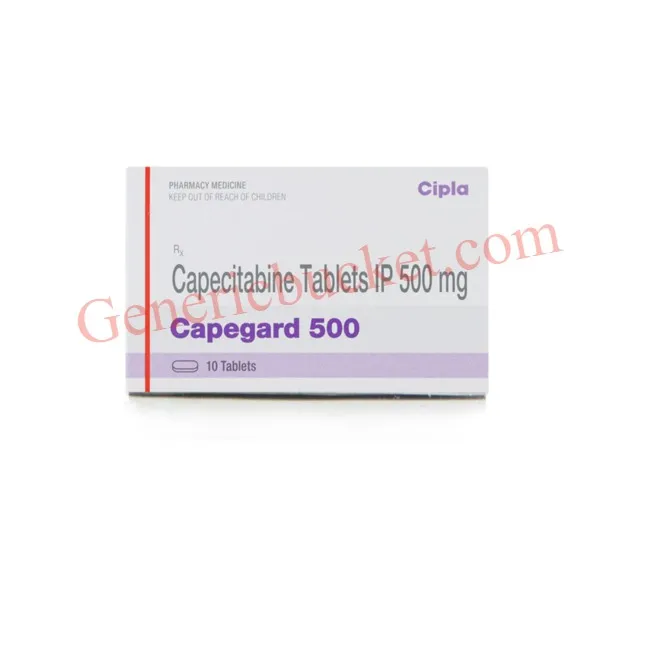

Capegard 500mg Tablet (Capecitabine 500mg)
Price range: $125.00 through $336.00
| Country of Origin | India |
|---|---|
| Dosage Form | Tablets |
| Equivalent Brand | Xeloda |
| Generic Name | Capecitabine |
| Indication | Ovarian cancer, Head and neck cancer, Cervical cancer |
| Manufacturer | Cipla Ltd |
| Packaging | 10 tablets in 1 strip |
| Composition | Capecitabine (500mg) |
| Capegard 500mg Tablet (Capecitabine 500mg) | |||
| Pack Size | Price | Price/Unit | Add To Cart |
| 50 Tablet/s | $125.00 (2.5/unit) | $2.5 | |
| 100 Tablet/s | $238.00 (2.38/unit) | $2.38 | |
| 150 Tablet/s | $336.00 (2.24/unit) | $2.24 | |
Capegard 500mg Tablet contains capecitabine 500 mg, an oral anticancer medicine prescribed as part of chemotherapy for certain cancers. If your oncologist has prescribed this medicine, understanding how it works, how to take it, and which warning signs require prompt medical attention can help you follow your treatment safely. Capegard 500mg Tablet is not a general-purpose cancer cure, and patients should use it only under the supervision of a qualified cancer specialist.
What is Capegard 500mg Tablet?
Capegard 500mg Tablet contains capecitabine, an antineoplastic medicine belonging to the antimetabolite class. After you take the tablet, your body converts capecitabine into an active form of chemotherapy, including 5-fluorouracil. This active medicine interferes with processes that cancer cells need to make and maintain DNA and RNA. By disrupting these processes, treatment can slow the growth and multiplication of susceptible cancer cells.
Doctors may prescribe Capegard 500mg Tablet alone or alongside other anticancer medicines depending on the type, stage, and treatment history of the cancer. The exact treatment plan varies considerably between patients, so you should never change the dose or treatment schedule without speaking with your oncology team.
Uses of Capegard 500mg Tablet
Doctors commonly use Capegard 500mg Tablet for certain breast, colorectal, colon, and rectal cancers. In appropriate patients, oncologists may use capecitabine after surgery, for advanced disease, or together with other chemotherapy medicines. The appropriate indication depends on the patient’s diagnosis and the overall treatment plan.
This medicine does not work in exactly the same way for every cancer patient. Your doctor considers cancer type, stage, previous treatments, kidney function, liver function, other medicines, and overall health before prescribing it. Therefore, patients should regard Capegard 500mg Tablet as an important component of a supervised cancer-treatment plan rather than as a self-treatment option.
How Capegard 500mg Tablet Works
Capecitabine acts as a prodrug. Your body converts it through several enzymatic steps into an active chemotherapy substance. The resulting active compound interferes with the production of genetic material required by rapidly dividing cells. Because cancer cells often divide rapidly, this interference can inhibit their growth and survival.
The medicine can also affect healthy cells that naturally divide quickly. This explains why chemotherapy can cause effects involving the digestive system, blood cells, skin, and other tissues. Your oncology team may monitor you closely and adjust treatment when necessary.
How to Take Capegard 500mg Tablet
Take Capegard 500mg Tablet exactly as prescribed. Product information advises taking the medicine with food, generally within 30 minutes after a meal. Swallow the tablet whole with water unless your healthcare professional gives you different instructions. Do not independently crush, chew, split, or alter the tablet.
Your oncologist determines the dose and treatment cycles. Some chemotherapy schedules use treatment periods followed by rest periods. Never increase the dose because you think the medicine is working slowly, and never reduce the dose without medical advice.
If you miss a dose, do not take an extra tablet to compensate. Contact your oncology team or pharmacist if you are uncertain about what to do. If vomiting occurs after a dose, ask your healthcare professional for individualized instructions rather than automatically repeating the dose.
Common Side Effects
Capegard 500mg Tablet may cause nausea, vomiting, diarrhea, abdominal discomfort, reduced appetite, tiredness, mouth sores, and changes in blood-cell counts. Some patients can also develop a hand-and-foot reaction involving redness, swelling, tingling, pain, or peeling of the palms and soles.
Not every patient experiences these effects, and their severity can vary. Tell your cancer-care team about persistent or troublesome symptoms. Early reporting allows your healthcare professionals to assess the problem and determine whether supportive treatment or a dose adjustment is necessary.
Important Safety Information
Capegard 500mg Tablet requires careful medical supervision. Your doctor may order blood tests and monitor kidney and liver function during treatment. Capecitabine can cause serious toxicity in susceptible patients, particularly those with complete DPD deficiency. Patients should discuss any history of unusual reactions to fluoropyrimidine medicines with their doctor before treatment.
Seek urgent medical advice for severe or persistent diarrhea, repeated vomiting, fever or signs of infection, significant mouth sores, severe skin reactions, unusual bleeding, chest pain, breathing difficulty, or severe weakness. Serious reactions can require immediate medical assessment.
Tell your doctor about every prescription medicine, nonprescription product, vitamin, and supplement you use. Capecitabine can interact with certain medicines, including warfarin, and your treatment team needs complete medication information before and during therapy.
Pregnant or breastfeeding patients should discuss treatment carefully with their oncology team because capecitabine can harm a developing or nursing infant. Patients who can become pregnant should follow their clinician’s advice regarding effective contraception during treatment.
Storage and Handling
Store Capegard 500mg Tablet according to the product label and keep it in its original packaging. Keep medicines away from children and avoid using damaged tablets. Do not share anticancer medication with another person, even if that person has similar symptoms or a similar diagnosis.
Why Choose Capegard 500mg Tablet?
When prescribed appropriately, oral capecitabine provides an option for delivering chemotherapy without requiring every dose to be administered intravenously. Its oral format can offer practical convenience while still requiring careful adherence, laboratory monitoring, and communication with the oncology team.
If your physician has prescribed Capegard 500mg Tablet, obtain it through a legitimate, licensed pharmacy and provide a valid prescription where required. Before ordering, confirm the strength, quantity, manufacturer, expiry information, and prescription requirements. Do not purchase an anticancer medicine solely because an online advertisement promises a cure.
Frequently Asked Questions
1. What is Capegard 500mg Tablet used for?
Capegard 500mg Tablet is an oral capecitabine chemotherapy medicine used for certain cancers, including some breast, colon, rectal, and colorectal cancers. Your oncologist determines whether it is appropriate for your particular diagnosis.
2. Is Capegard 500mg Tablet a cancer cure?
No medicine should be marketed as a guaranteed cure for cancer. Capegard 500mg Tablet is a chemotherapy medicine that can help treat certain cancers by interfering with cancer-cell growth. Treatment outcomes depend on many individual factors.
3. How should I take Capegard 500mg Tablet?
Follow your oncologist’s exact instructions. Product information recommends taking capecitabine with food, within about 30 minutes after a meal. Do not change the prescribed schedule yourself.
4. What are the most common side effects?
Common effects can include diarrhea, nausea, vomiting, appetite changes, fatigue, mouth sores, and hand-and-foot skin reactions. Contact your healthcare team if symptoms become severe or persistent.
5. What is hand-foot syndrome?
It is a treatment-related skin reaction that may cause redness, swelling, tingling, tenderness, pain, or peeling on the hands and feet. Report symptoms early so your healthcare team can manage them appropriately.
Be the first to review “Capegard 500mg Tablet (Capecitabine 500mg)”
Related products

Anti Cancer

Anti Cancer

Anti Cancer
Anti Cancer
Anti Cancer

Anti Cancer

Anti Cancer

Anti Cancer

Anti Cancer

Anti Cancer


Anti Cancer
Reviews
There are no reviews yet.