
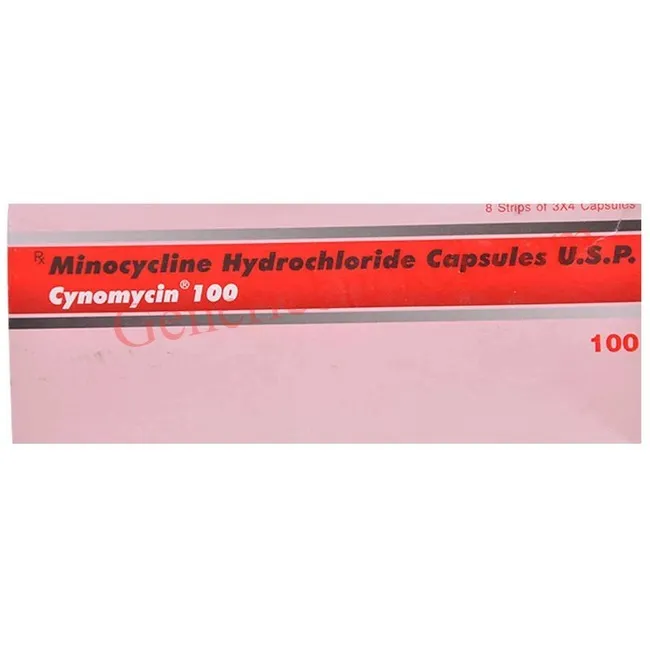

Cynomycin 100mg Capsule (Minocycline 100mg)
Price range: $56.00 through $142.00
| Country of Origin | India |
|---|---|
| Dosage Form | Capsules |
| Equivalent Brand | Minocin |
| Generic Name | Minocycline |
| Indication | Bacterial infections |
| Manufacturer | Wyeth Pfizer Ltd |
| Packaging | 4 capsules in 1 strip |
| Composition | Minocycline (100mg) |
| Pack Size | 28 Capsule/s, 56 Capsule/s, 84 Capsule/s |
| Cynomycin 100mg Capsule (Minocycline 100mg) | |||
| Pack Size | Price | Price/Unit | Add To Cart |
| 28 Capsule/s | $56.00 (2/unit) | $2 | |
| 56 Capsule/s | $108.00 (1.93/unit) | $1.93 | |
| 84 Capsule/s | $142.00 (1.69/unit) | $1.69 | |
Cynomycin 100mg Capsule is a prescription antibiotic containing minocycline 100 mg, a tetracycline-class antibacterial medicine used to treat susceptible bacterial infections. It may also be prescribed for certain forms of moderate-to-severe inflammatory acne. Because antibiotics do not work against viruses, you should use this medicine only when a healthcare professional has determined that a bacterial infection requires treatment. Pfizer’s product information confirms that each 100 mg capsule contains minocycline hydrochloride equivalent to 100 mg of minocycline.
What Is Cynomycin 100mg Capsule?
Cynomycin 100mg Capsule contains minocycline, an antibiotic that stops susceptible bacteria from producing proteins they need to grow and multiply. By limiting bacterial growth, the medicine helps your immune system control and clear the infection. Healthcare professionals may prescribe minocycline for specific respiratory, skin, eye, and other bacterial infections when the responsible organism is susceptible to the medicine. It can also have anti-inflammatory effects, which explains its use in selected acne treatment plans.
This medicine does not treat common viral illnesses such as colds or influenza. Using an antibiotic when you do not need one can contribute to antibiotic resistance and may expose you to unnecessary adverse effects. Your prescriber should therefore select minocycline based on your diagnosis and medical history.
Cynomycin 100mg Capsule Uses
Doctors may use Cynomycin 100mg Capsule for certain bacterial infections involving the skin, respiratory tract, urinary tract, eyes, or other susceptible sites. It may also be prescribed for inflammatory acne. The exact indication depends on the bacteria involved, local resistance patterns, your medical history, and your healthcare professional’s assessment.
For acne, minocycline can reduce acne-associated bacterial activity and inflammation. It generally forms only one part of an acne treatment plan, and your dermatologist may combine oral treatment with appropriate topical therapy depending on the severity and type of acne.
How Cynomycin 100mg Capsule Works
Minocycline belongs to the tetracycline antibiotic family. It enters susceptible bacterial cells and interferes with bacterial protein production. Without adequate protein production, bacteria cannot grow and reproduce normally. This antibacterial action allows the body’s natural defenses to eliminate the remaining organisms.
The anti-inflammatory properties of minocycline can also help reduce inflammatory acne lesions. However, improvement varies between individuals, and you should not increase the dose simply because symptoms do not improve immediately.
How to Take Cynomycin 100mg Capsule
Take Cynomycin 100mg Capsule exactly as your prescriber directs. Swallow the capsule with plenty of water and do not crush or chew it unless your pharmacist or doctor specifically tells you otherwise. Follow the prescribed schedule and complete the treatment course even if you begin feeling better, unless your healthcare professional tells you to stop. Stopping an antibiotic prematurely can allow surviving bacteria to persist and may contribute to treatment failure or resistance.
If you miss a dose, take it when you remember unless it is nearly time for the next dose. In that situation, skip the missed dose and return to your normal schedule. Do not take two doses together to compensate for a missed dose.
Related Product
Important Interactions and Precautions
Minocycline can interact with certain medicines and supplements. Products containing iron, calcium, magnesium, aluminum, or other minerals can interfere with tetracycline absorption, so ask your pharmacist how to separate these products from your antibiotic. Tell your healthcare professional about every prescription medicine, nonprescription medicine, vitamin, and supplement you use.
Minocycline can cause dizziness or light-headedness in some people. If you experience these effects, avoid driving or operating machinery until you know how the medicine affects you. It can also increase sensitivity to sunlight, so minimize unnecessary sun exposure and use protective clothing and sunscreen.
Pregnant patients should discuss minocycline with their healthcare professional before taking it. Tetracycline-class medicines can affect fetal tooth and bone development. Minocycline also generally should not be used during tooth development in young children because permanent tooth discoloration and enamel effects can occur.
Tell your prescriber if you have liver or kidney problems, a history of antibiotic allergy, or other significant medical conditions. Your healthcare team can determine whether minocycline remains appropriate and whether monitoring is necessary.
Common Side Effects
Possible side effects of minocycline include dizziness, nausea, vomiting, diarrhea, headache, and other gastrointestinal symptoms. Some people may also experience increased sensitivity to sunlight. Many adverse effects are mild, but persistent or troublesome symptoms deserve medical advice.
Seek prompt medical attention for serious symptoms such as severe allergic reactions, significant skin reactions, unusual severe headache or visual changes, yellowing of the skin or eyes, or other symptoms that concern you. Do not ignore severe or rapidly worsening reactions.
Why Choose Prescription-Based Treatment?
Buying Cynomycin 100mg Capsule should never replace professional medical evaluation. A healthcare professional needs to determine whether your symptoms actually result from bacteria and whether minocycline is the appropriate antibiotic. A prescription also helps ensure that you receive the correct strength, instructions, and treatment duration.
When ordering, use a legitimate pharmacy and provide a valid prescription when required. Do not purchase antibiotics from unverified sellers or use someone else’s prescription. Prescription status and dispensing requirements vary by country and jurisdiction.
Frequently Asked Questions
What is Cynomycin 100mg Capsule used for?
Cynomycin 100mg Capsule contains minocycline and is prescribed for susceptible bacterial infections. It may also be used in selected cases of inflammatory acne.
Is Cynomycin 100mg Capsule an antibiotic?
Yes. Minocycline is a tetracycline-class antibiotic that inhibits bacterial protein synthesis and prevents susceptible bacteria from multiplying.
Can Cynomycin 100mg Capsule treat acne?
Minocycline can be prescribed for moderate-to-severe inflammatory acne. Your dermatologist determines whether oral antibiotic therapy is appropriate for your particular acne.
Can I stop the medicine when I feel better?
Do not stop an antibiotic early unless your prescriber instructs you to do so. Follow the complete treatment plan prescribed for your infection.
Can I take vitamins with minocycline?
Some mineral-containing supplements, particularly those containing iron, calcium, magnesium, or aluminum, can interfere with absorption. Ask your pharmacist about the appropriate timing for supplements.
Be the first to review “Cynomycin 100mg Capsule (Minocycline 100mg)”
Related products




Reviews
There are no reviews yet.