
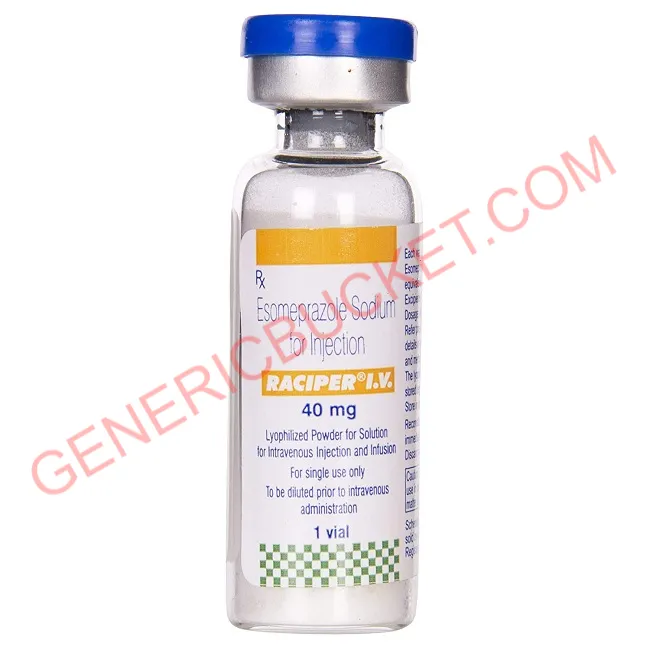

Raciper IV Injection (Esomeprazole 40mg)
Price range: $34.00 through $124.00
| Country of Origin | india |
|---|---|
| Dosage Form | Injection |
| Generic Name | Esomeprazole |
| Indication | Treatment of Gastroesophageal reflux disease (Acid reflux) |
| Packaging | 5 ml in 1 vial |
| Manufacturer | Sun Pharmaceutical Industries Ltd |
| Composition | Esomeprazole (40mg) |
| Raciper IV Injection (Esomeprazole 40mg) | |||
| Pack Size | Price | Price/Unit | Add To Cart |
| 5 Injection/s | $34.00 (6.8/unit) | $6.8 | |
| 10 Injection/s | $64.00 (6.4/unit) | $6.4 | |
| 20 Injection/s | $124.00 (6.2/unit) | $6.2 | |
Raciper IV Injection is a prescription proton-pump inhibitor (PPI) containing esomeprazole, which reduces the production of stomach acid. Product listings identify the injection as esomeprazole 40 mg in a 5 mL vial. Healthcare professionals may use it when intravenous acid suppression is appropriate, particularly when a patient cannot take medicine by mouth. Raciper IV Injection may be used for acid-related gastrointestinal conditions, including gastroesophageal reflux disease (GERD), erosive esophagitis, and certain ulcer-related conditions.
Excess stomach acid can irritate the esophagus and stomach lining, causing symptoms such as heartburn, acid regurgitation, and upper abdominal discomfort. By reducing acid secretion, Raciper IV Injection can help create an environment that supports healing and relieves acid-related symptoms. Because this is an intravenous medicine, a doctor or trained healthcare professional must determine whether it is appropriate for the individual patient.
What Is Raciper IV Injection Used For?
Doctors may prescribe Raciper IV Injection when acid suppression is medically necessary and intravenous administration is preferred. It can be used in the management of GERD and acid-related disorders and may also have a role in ulcer treatment under appropriate clinical circumstances. Some clinical uses involve preventing or managing complications associated with excessive gastric acid production.
For hospitalized or seriously ill patients, intravenous proton-pump inhibitor therapy may be considered when oral treatment is temporarily unsuitable. The exact indication, dose, and duration depend on the patient’s diagnosis, age, clinical condition, and ability to take medication orally.
Patients should not interpret Raciper IV Injection as a general treatment for every type of stomach pain. Abdominal discomfort can have many causes, and a healthcare professional should identify the underlying condition before treatment begins.
How Does Raciper IV Injection Work?
Raciper IV Injection works by suppressing the gastric proton pump, an enzyme system responsible for the final stage of stomach-acid secretion. Esomeprazole decreases the amount of acid released into the stomach. Lower acid levels can reduce irritation and help acid-damaged tissues heal.
This mechanism makes Raciper IV Injection different from medicines that simply neutralize acid already present in the stomach. Instead, it decreases new acid production. This effect can provide sustained acid suppression when prescribed appropriately.
Administration and Dosage
A healthcare professional administers Raciper IV Injection directly into a vein. Patients should never attempt to inject this medicine themselves. The healthcare provider determines the appropriate dose and administration method according to the condition being treated.
For some conditions, intravenous esomeprazole is intended for short-term use, followed by conversion to an oral acid-suppressing medicine when the patient can take medication by mouth. The treatment plan varies considerably between conditions, so patients should follow the prescribed schedule rather than adjusting the dose independently.
Do not request an IV injection simply because you believe it will work faster than a tablet. Intravenous treatment is generally selected for specific clinical circumstances.
Benefits of Raciper IV Injection
The main benefit of Raciper IV Injection comes from its ability to reduce excessive gastric acid production. This action may help relieve acid-related discomfort and support healing of acid-associated injury.
For patients with GERD, reducing acid exposure can help manage heartburn and acid regurgitation. In appropriate ulcer-related conditions, reducing gastric acid can support the healing process. Intravenous administration can also provide an alternative when oral administration is temporarily unsuitable.
However, Raciper IV Injection does not cure every underlying cause of gastrointestinal symptoms. Your healthcare professional may need to investigate infection, medication-related injury, bleeding, or other gastrointestinal disorders before choosing treatment.
Related Product
Possible Side Effects
Some patients may experience headache, nausea, vomiting, abdominal discomfort, diarrhea, flatulence, or an injection-site reaction after receiving esomeprazole. Many side effects are mild, but patients should tell their healthcare provider if symptoms persist or become troublesome.
Seek prompt medical attention for severe or unusual symptoms. Prolonged or high-dose PPI treatment can require additional monitoring because long-term acid suppression may be associated with problems such as low magnesium, vitamin B12 deficiency, and bone-related complications in some patients.
Precautions and Drug Interactions
Before receiving Raciper IV Injection, tell your doctor about allergies, liver disease, kidney problems, pregnancy, breastfeeding, and every medicine or supplement you use. Esomeprazole can interact with certain medicines, and the healthcare professional may need to adjust therapy or monitor you more closely. Reported medicines of concern include some antiretrovirals, clopidogrel, and certain high-dose methotrexate regimens.
Patients with severe liver impairment may require special consideration. Never use an injectable prescription medicine without professional evaluation.
Storage and Handling
Healthcare facilities should store Raciper IV Injection according to the manufacturer’s labeled storage requirements. One current product listing specifies storage below 25°C. The vial should remain properly handled and protected according to its official product instructions.
Why Choose Raciper IV Injection?
When a clinician determines that intravenous esomeprazole is appropriate, Raciper IV Injection provides a targeted approach to reducing gastric acid. Its PPI mechanism makes it useful in selected acid-related gastrointestinal conditions.
Because it is a prescription injection, quality, authenticity, proper storage, and professional administration matter. Patients should obtain Raciper IV Injection only through a legitimate, licensed pharmacy or healthcare provider and should use it exactly as prescribed.
Frequently Asked Questions
1. What is Raciper IV Injection used for?
It is used to reduce stomach-acid production in selected acid-related conditions, including GERD and certain ulcer-related disorders.
2. What is the active ingredient?
Current product information identifies esomeprazole 40 mg as the active ingredient in the 5 mL injection.
3. Can I administer Raciper IV Injection myself?
No. A doctor, nurse, or other appropriately trained healthcare professional should administer the intravenous injection.
4. Can Raciper IV Injection treat heartburn?
It can reduce the stomach acid that contributes to acid reflux and heartburn. Your doctor should determine whether esomeprazole is appropriate for your symptoms.
5. How quickly does Raciper IV Injection work?
The timing depends on the condition, dose, and individual response. Your healthcare professional can explain what to expect from the prescribed treatment.
Be the first to review “Raciper IV Injection (Esomeprazole 40mg)”
Related products
Acid Reducers
Acid Reducers
Acid Reducers
Acid Reducers
Acid Reducers

Acid Reducers

Acid Reducers

Acid Reducers

Acid Reducers

Acid Reducers

Acid Reducers

Acid Reducers
Reviews
There are no reviews yet.