
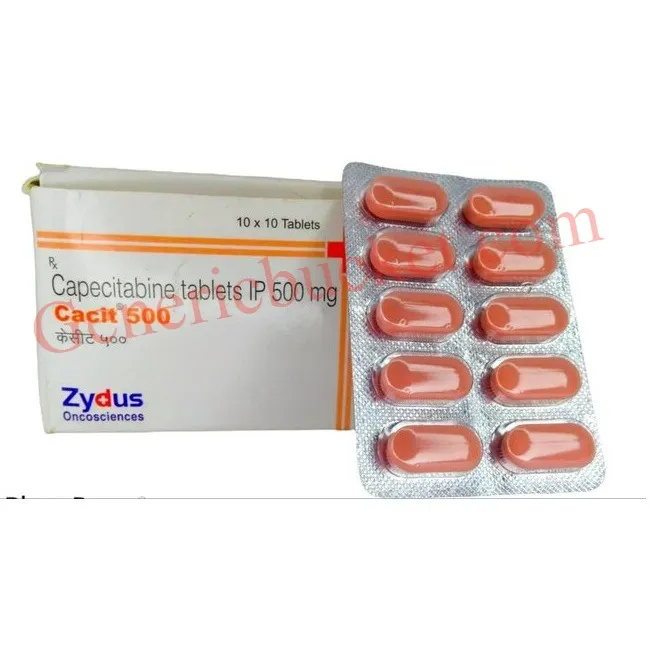

Cacit 500mg Tablet (Capecitabine 500mg)
Price range: $196.00 through $554.00
| Country of Origin | india |
|---|---|
| Dosage Form | Tablets |
| Generic Name | Capecitabine |
| Indication | Breast cancer |
| Packaging | 10 tablets in 1 strip |
| Manufacturer | Biochem Pharmaceutical Industries |
| Composition | Capecitabine (500mg) |
| Cacit 500mg Tablet (Capecitabine 500mg) | |||
| Pack Size | Price | Price/Unit | Add To Cart |
| 50 Tablet/s | $196.00 (3.92/unit) | $3.92 | |
| 100 Tablet/s | $380.00 (3.8/unit) | $3.8 | |
| 150 Tablet/s | $554.00 (3.69/unit) | $3.69 | |
Cacit 500mg Tablet is a prescription medicine whose active ingredient is capecitabine 500 mg, an oral chemotherapy medicine used under specialist supervision for certain cancers. It belongs to the fluoropyrimidine group and helps slow or stop the growth of cancer cells. It may be prescribed for certain breast, colorectal, colon, rectal, and other cancers depending on the patient’s diagnosis and treatment plan.
What is Cacit 500mg Tablet?
Cacit 500mg Tablet contains capecitabine, which the body converts into 5-fluorouracil (5-FU), an active anticancer substance. Cancer cells often divide more rapidly than normal cells. Capecitabine ultimately interferes with processes that cancer cells need to make DNA and multiply. This can slow cancer progression or destroy susceptible cancer cells.
Your oncologist chooses the dose and treatment schedule according to your cancer type, treatment goal, body size, kidney function, other medicines, and previous treatments. Because chemotherapy affects each person differently, you should follow the exact regimen prescribed for you rather than copying another patient’s schedule.
Uses of Cacit 500mg Tablet
Doctors may prescribe Cacit 500mg Tablet for selected cancers, including certain breast cancer, colorectal cancer, colon cancer, and rectal cancer. It can be used alone or alongside other anticancer medicines when clinically appropriate.
The precise indication matters because cancer treatment depends on the cancer’s location, stage, biomarkers, previous therapy, and overall health. Your oncology team may therefore combine capecitabine with surgery, radiation, targeted treatment, immunotherapy, or another chemotherapy medicine when appropriate.
How Does Cacit 500mg Tablet Work?
After you swallow capecitabine, your body converts it through several steps into 5-FU. This active substance interferes with thymidylate production and other cellular processes required for DNA synthesis. Rapidly dividing cancer cells can therefore have difficulty continuing to grow and reproduce.
This mechanism also explains why treatment can affect some healthy cells that naturally divide quickly, including cells in the digestive tract and bone marrow. As a result, side effects can occur even though the medicine is intended to target cancer. Your healthcare team monitors you throughout treatment to balance effectiveness with safety.
How to Take Cacit 500mg Tablet
Take Cacit 500mg Tablet exactly as prescribed by your oncologist. Product information advises taking capecitabine with food, generally within 30 minutes after a meal. Swallow the tablets with water and follow your prescribed schedule carefully.
Do not independently increase, decrease, skip, or repeat a dose. Chemotherapy regimens commonly involve treatment periods followed by rest periods, but your schedule may differ. If you vomit after taking a dose or forget a dose, contact your oncology team for specific instructions rather than automatically taking another tablet.
Common Side Effects
Treatment with Cacit 500mg Tablet can cause side effects. Commonly reported reactions include nausea, vomiting, diarrhea, abdominal discomfort, weakness, reduced appetite, and changes in blood-cell counts. Hand-foot syndrome, which can cause redness, swelling, tenderness, burning, or peeling of the hands and feet, can also occur.
Tell your healthcare team about troublesome symptoms early. Early management can sometimes prevent a side effect from becoming more severe.
Serious Safety Information
Seek urgent medical advice if you develop severe or persistent diarrhea, repeated vomiting, significant mouth sores, fever or signs of infection, unusual bleeding, severe chest pain, breathing difficulty, or marked skin reactions.
Capecitabine can cause serious toxicity in people with DPD (dihydropyrimidine dehydrogenase) deficiency. Your medical team should consider appropriate evaluation and prescribing precautions. Kidney and liver problems can also affect treatment decisions, so tell your doctor about any history of these conditions.
Capecitabine can interact with other medicines. In particular, tell your doctor if you use blood thinners, seizure medicines, antiviral medicines, or other prescription, nonprescription, or herbal products. Some combinations can produce dangerous reactions.
Pregnancy and Breastfeeding
Capecitabine can harm an unborn baby. Tell your oncologist immediately if you are pregnant, think you could be pregnant, or plan to become pregnant. Appropriate contraception should be discussed with your healthcare professional during treatment and for the period recommended by your oncology team.
Breastfeeding is generally not recommended during capecitabine treatment. Discuss your individual situation with your oncologist before starting therapy.
Why Professional Supervision Matters
Cacit 500mg Tablet is not an ordinary supplement or over-the-counter medicine. It is cytotoxic chemotherapy and requires individualized prescribing, monitoring, and follow-up. Your doctor may order blood tests and monitor kidney and liver function and other parameters during treatment.
For this reason, patients should purchase prescription chemotherapy only through a legitimate pharmacy and use it exactly as directed by their treating oncology team. Do not purchase or use it simply because another person received the same strength.
Storage and Handling
Store the medicine according to the product label and pharmacy instructions. Keep it away from children and pets. Do not use tablets that are damaged or past their expiration date. Because capecitabine is a chemotherapy medicine, ask your pharmacist or oncology team how to dispose of unused tablets safely rather than throwing them away without guidance.
Frequently Asked Questions
1. What is Cacit 500mg Tablet used for?
It contains capecitabine and may be prescribed for certain cancers, including selected breast, colon, rectal, and colorectal cancers. The indication depends on the patient’s individual cancer diagnosis and treatment plan.
2. Is Cacit 500mg Tablet a chemotherapy medicine?
Yes. Capecitabine is an oral fluoropyrimidine chemotherapy medicine. Your oncologist determines whether it is appropriate and how it should be combined with other treatments.
3. Can I take Cacit 500mg Tablet without a prescription?
No. Capecitabine requires medical supervision because dosing, interactions, kidney function, blood counts, and adverse effects require professional assessment.
4. Should I take it with food?
Capecitabine product information recommends taking the medicine with food, generally within 30 minutes after eating. Follow the exact instructions supplied with your prescription.
5. What happens if I miss a dose?
Do not automatically double the next dose. Contact your oncology team and follow their missed-dose instructions.
Related products
Anti Cancer


Anti Cancer

Anti Cancer
Anti Cancer
Anti Cancer

Anti Cancer
Anti Cancer

Anti Cancer

Anti Cancer
Anti Cancer

Anti Cancer